Podcast Summary
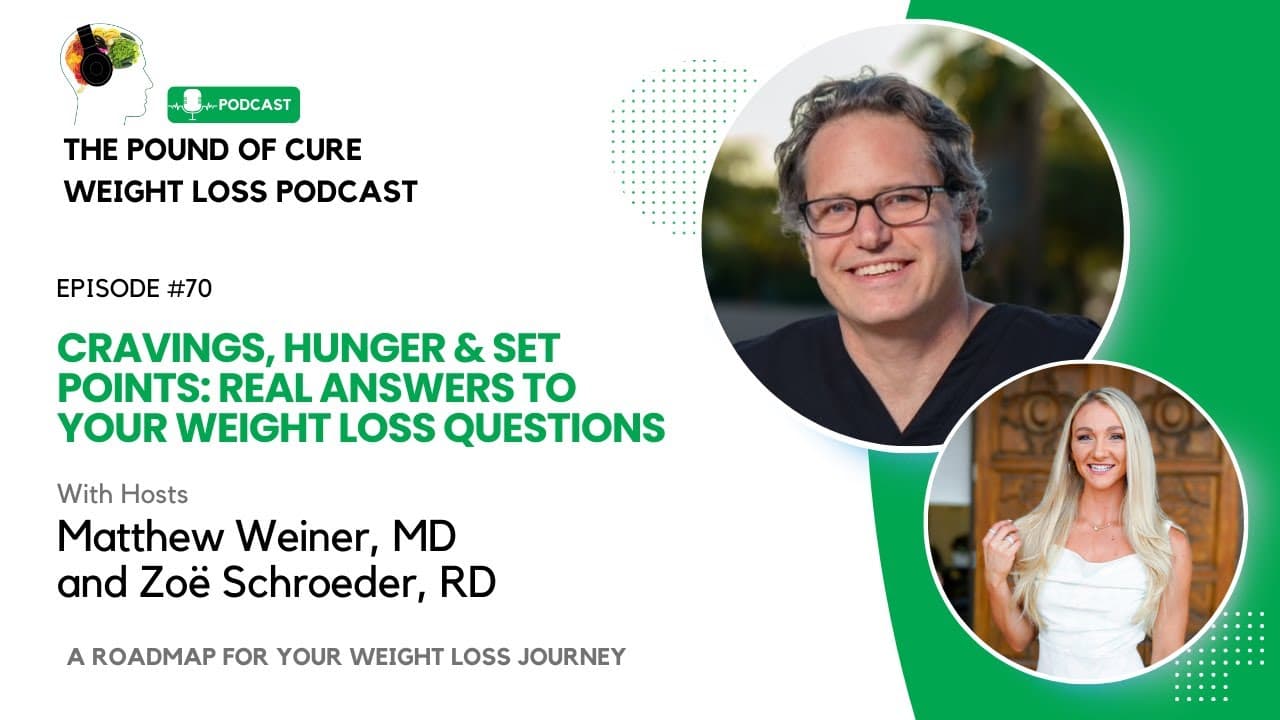
Episode 70: Cravings, Hunger & Set Points: Real Answers to Your Weight Loss Questions
In this listener Q&A episode of the Pound of Cure Weight Loss Podcast, Dr. Matthew Weiner and registered dietitian Zoë tackle some of the most common and misunderstood challenges in weight loss. They answer questions submitted by viewers on YouTube, covering goal weights, sugar cravings, insurance barriers to medication, and persistent hunger after bariatric surgery.
Setting Realistic Goal Weights: Beyond BMI
The first question addresses how to set a realistic goal weight. Should it be a specific number, a range, or based on body composition? The listener mentions feeling confused because BMI charts suggest one thing, but her body composition tells a different story.
Talk with our team
Have questions about this episode?
Send our Tucson weight loss team a note about bariatric surgery, GLP-1 medications, nutrition, or your next step with Pound of Cure.
More from this episode
Zoë emphasizes that BMI (body mass index) is problematic because it only measures the ratio of height to weight, ignoring muscle mass versus fat mass entirely. Competitive bodybuilders, for example, can register as obese on BMI charts despite having very low body fat.
Instead of fixating on a specific number, Zoë encourages patients to focus on body composition. She asks patients: if you felt confident in your body, were fitting into your clothes better, and felt strong in the gym, would you care more about that or about seeing a specific number on the scale? Nearly everyone chooses the former.
Zoë shares that patients often feel frustrated when they only lose one pound in a month, but then she discovers they have lost two inches off their waist. If your weight stays the same but your measurements decrease, your body is taking up less space. This means you are likely building muscle while losing fat, which is more exciting than a number on the scale.
Clothing size is another useful metric. It provides a broader range than a single number and reflects how you actually look and feel in daily life.
Dr. Weiner's Approach to Expected Weight Loss
Dr. Weiner explains that in his practice, the focus is not on what you should weigh, but on expected weight loss based on the treatments you choose. He walks through this process with every new patient at their first visit.
He breaks down the three main treatment categories: nutrition, medications, and surgery. The question is not which one to choose, but how to use all three strategically.
Nutrition Alone
If you lose 10 percent of your body weight through nutrition alone, that is amazing and very difficult to achieve. For a 300-pound person, that would be 30 pounds. While 270 pounds is still a high weight, this amount of weight loss produces significant health benefits like lower blood pressure and better blood glucose control. Dr. Weiner would still discuss medications and surgery with this patient, but 30 pounds would be the realistic goal with nutrition only.
Medications (GLP-1s)
With medications such as GLP-1 drugs, depending on the medication and dosage available, patients generally see 15 to 20 percent total body weight loss. For a 300-pound person, that translates to 45 to 60 pounds, bringing them to around 250 pounds. This is not a judgment about what they should weigh, but a realistic expectation based on the science of these medications combined with good nutrition.
Bariatric Surgery
For surgery, Dr. Weiner uses a calculator available on the Pound of Cure website. Patients can plug in their information and receive expected weight loss numbers for both sleeve gastrectomy and gastric bypass. He uses these numbers to help guide surgical decision making.
Stacking Treatments: How the Math Works
Zoë asks an important question: do the percentages stack? If you lose 10 percent from nutrition, 15 percent from medications, and more from surgery, how does the math work?
Dr. Weiner clarifies that nutrition does not count separately in bariatric surgery calculations. The expected weight loss from surgery already assumes patients are eating well. Almost everyone in his practice eats very well after surgery, at least initially. So you cannot add nutrition on top of surgical weight loss expectations.
However, medications do stack on top of surgery, but the calculation is important. You first subtract the surgical weight loss, then apply the medication percentage. For example, if you weigh 300 pounds and are expected to lose 100 pounds from surgery, your new weight is 200 pounds. The 15 to 20 percent from medications comes off that 200 pounds, not the original 300. Dr. Weiner usually rounds up a bit because the interaction is not perfectly clean, but medications tend to add on top of surgery with less overlap than he originally expected.
This approach allows him to map out a treatment plan and set realistic expectations for every patient based on the therapies they select.
Conquering Sugar Cravings with Protein and Fiber
The second question comes from a listener who experienced horrible sugar cravings for a month, then increased her vegetable and fiber intake to 20 to 25 grams daily and protein to over 100 grams. Surprisingly, the sugar cravings completely disappeared. She asks whether it was the protein or the fiber that caused this.
Zoë explains it is likely both working together. Fiber provides volume and fills you up. Protein satisfies you and keeps you full for longer than an hour. Together, protein and fiber form the meal formula for reducing food noise and cravings. Zoë works with patients to build their meals around these two components so they feel full and stay full.
Dr. Weiner asks a provocative question: everyone counts calories and carbs, but nobody counts fiber. Why is that? Fiber is important enough that it should be tracked.
Zoë points out that fiber counting has been complicated by the keto and low-carb product industry. The concept of net carbs (total carbohydrates minus fiber) is largely a marketing scam. Some low-carb tortillas and protein bars claim 14 or 15 grams of fiber, but this processed fiber does not have the same effect as 14 grams of fiber from vegetables.
Instead of focusing on fiber grams on a label, Zoë recommends counting ounces or pounds of vegetables. Using the Pound of Cure app and the Metabolic Reset Diet, patients work toward eating a pound of vegetables per day. If you achieve that, you will get enough fiber.
Nutrient Deficiencies Drive Cravings
Dr. Weiner adds another layer to the sugar craving explanation. Humans and other animals have an inherent ability to sense nutrient deficiencies and crave foods that contain those nutrients. He references the story of orphans who drank cod liver oil because they were vitamin D deficient and could somehow sense the oil was rich in vitamin D. This is similar to pica, where people with iron deficiency crave ice or dirt.
Processed foods exploit this system. If you are deficient in a phytonutrient found in cherries, you might crave cherry-flavored candy. But eating the artificial cherry flavor does not provide the nutrient, so you keep eating and eating without satisfaction.
When you eat real vegetables and fruits rich in phytonutrients, you satisfy those deficiencies and the cravings stop. If you struggle with food cravings, increasing vegetables, fruits, nuts, seeds, and beans can help.
Zoë emphasizes that it is not about restricting sugar. The more you focus on restriction, the more you want it. Instead, crowd out the sugar by filling your diet with whole foods, fiber-rich vegetables, and healthy proteins.
Calorie Ratio: The Only System Where You Eat More
Dr. Weiner highlights that Calorie Ratio, the food logging system used in the Pound of Cure app, is unique. It is the only system he knows where you can increase your score by eating more food. Every other system is about restriction. If you add more broccoli to your diet, your Calorie Ratio score goes higher. This encourages a mindset that eating healthy foods is good and you should eat as much as you can, which is very different from cutting carbs or calories.
Zoë shares that she recently led a new support group called Intro to the App, which is free even for non-members. She walked participants through using Calorie Ratio by entering a nutritious breakfast that scored 100 percent, then pizza for lunch that dropped the score, then showed how to bring the score back up with a healthy dinner. This demonstrates her philosophy: always follow your fun food with a fuel food. Adding nutrient-dense foods after an indulgence prevents a snowball effect.
Insurance Does Not Cover GLP-1s: What Now?
The third question is from someone whose insurance does not cover GLP-1 medications unless they have diabetes. Their doctor says the medication would help, but insurance says no. They have 35 pounds of weight regain to lose after a broken leg.
Dr. Weiner appreciates that the person acknowledges the injury as a cause of weight gain. Injury is on their intake questionnaire and is discussed regularly. Weight regain after bariatric surgery is incredibly treatable with GLP-1 medications, making it almost a non-issue clinically. The real issue is access.
Dr. Weiner explains that the Platinum program at Pound of Cure can set patients up for about $250 per month, including everything: the medications and the program support. They use real FDA-approved medications and have developed techniques and creative dosing strategies to keep costs down. They know about all the deals and discounts available.
When patients regain 35 pounds, they often spiral into anxiety, worrying they will regain everything and become another failure. Dr. Weiner tries to reframe the situation: you do not have an unsolvable problem. You have a $250-per-month problem. While $250 per month is not nothing, it is not the same as the world caving in.
Some patients get a side gig like Uber Eats or Instacart to cover the cost. Delivering food or shopping for groceries two days a month can generate $250. It sounds crazy, but it beats the worry and stress.
About 90 to 95 percent of weight regain after bariatric surgery is very treatable with these medications. If insurance will not cover it, convincing them is a dead end. The solution is finding the cheapest way to get the medication.
Warning About Peptides and Retatrutide
Dr. Weiner warns against the growing trend of using peptides, which are sketchier than compounded medications. He specifically cautions against taking Retatrutide, which is not FDA approved. He has concerns about its safety and believes it may increase cardiovascular events. Because the studies have not been done, patients taking it are guinea pigs. It is not worth the risk when proven, safe solutions exist.
The Platinum program details are available through the Pound of Cure website, and patients can now sign up directly through the app.
Persistent Hunger After Bariatric Surgery
The fourth question addresses feeling hungry almost all the time, even after bariatric surgery. The person had a sleeve gastrectomy three and a half years ago, and their hunger never fully went away. For the past six months, they have been absolutely ravenous, waking up in the middle of the night starving and waking up hungry in the morning.
Dr. Weiner's answer is straightforward: if you have had a sleeve, you probably need medications. This is true about 90 percent of the time. The answer to durable, sustainable weight loss, weight maintenance, and hunger control is a sleeve combined with medications. It is rarely the sleeve alone. This is not discussed as often as it should be. Sleeve and medications together work fantastically, but it is the combination that matters.
Zoë's nutritional perspective is simple: if you are feeling hungry, eat more food. Of course, it matters what you eat more of. This person could feel satisfied on relatively small amounts for the first three years after surgery, but that hunger suppression and decreased food noise do not last forever. That is the whole point of the surgery, but it is not permanent.
As the honeymoon period gets farther away and hunger returns, the solution is to eat more food, but to focus on fiber and vegetables. If you are still relying primarily on protein shakes three and a half years out, consider swapping them for whole food protein sources. Look at the quality and volume of your food. Let go of the rule that you should only eat a certain small amount. That is a made-up rule.
Dr. Weiner adds that they talk frequently about the portion control trap. People believe the surgery will take care of portions forever, but it does not over the long run. That is where diet quality and food type become critical. Zoë's statement is beautifully simple: if you are hungry, eat more food. Just focus on what you eat.
If you try to willpower your way through eating the same small amount you had before, your metabolic thermostat and set point will fight against you. That is the old broken system of eating less to lose weight, and it does not work.
Ultra-Processed Foods Quiet Hunger Better Than Whole Foods
The final question is challenging: the person feels that ultra-processed foods are much better at quieting hunger than whole foods. They do not believe celery with peanut butter would satisfy them for breakfast. What advice do you have for people like this?
Zoë shares that she recently worked with a patient in a one-on-one session who had a similar experience. This patient had wanted to move away from processed foods for years and was finally doing it, but felt more hungry and had more cravings. Zoë was surprised by this, and seeing another person with the same issue made it clear this is worth discussing.
The patient Zoë worked with is on GLP-1 medications and was trying to eat three square meals a day. She was force-feeding herself past the point of fullness to get a pound of vegetables in. Zoë told her to eat until full, but never to force-feed herself to the point of discomfort. They shifted to eating on a schedule every couple of hours, still including protein and fiber, but in smaller, more frequent meals. Being more mindful and present during eating helps. Zoë also believes the anxiety and stress around the issue made it worse. When you hyper-fixate on something not working, it can make the problem feel bigger.
Dr. Weiner offers a different perspective. He says: I find that smoking cigarettes is much more relaxing to me than meditating, so I am going to continue to smoke. This makes the underlying addiction to nicotine obvious. Similarly, if ultra-processed foods feel more satisfying than whole foods, there is probably some degree of food addiction at play. This could be addiction to sugar, to the blood sugar spike from processed carbohydrates, to artificial sweeteners, or to the dopamine hit from fatty and sugary combinations.
The person who can only relax when smoking cigarettes will eventually be able to relax without cigarettes after the addiction wanes. The same is true with food addiction. Dr. Weiner suggests this should be addressed as an addiction.
He mentions that older medications like Contrave and Topamax, which he does not use frequently, might be worth trying in someone like this. GLP-1 medications can also help patients get through the addiction period. The key is to look at this as an addiction rather than actual satiety.
Zoë adds that peanut butter and celery would not be enough for her for breakfast either. She suggests augmenting the meal with something like a veggie egg scramble, plus celery or apple with peanut butter. This provides volume, nutrients, and sets you up for success. If you are just trying to eat celery with peanut butter, you need to boost the volume for breakfast.
Some people are breakfast eaters and some are not. If you are a breakfast eater, consider a big veggie scramble with more animal protein, which tends to be more filling.
Zoë shares her own breakfast example: she loves shredded carrots in her eggs. She had almost a cup of shredded carrots, a cup of spinach, cooked them together, added egg whites and seasoning for a big plate, then had a banana with peanut butter. She had gone for a run that morning and was very hungry, so she ate it all. She was extremely full. Sometimes you just need to try different things until you find something that works and satisfies you in the morning.
Keep the Questions Coming
The hosts encourage listeners to keep submitting questions, especially on their YouTube channel. If this episode feels relevant to anyone in your life, please share it. They are working to help as many people as possible get to the root of long-lasting, healthy, happy weight loss without keeping you starving.
You can download the Pound of Cure app to access Calorie Ratio, the Metabolic Reset Diet, and the Platinum program. The app also offers free support groups, including the new Intro to the App session.
Dr. Weiner and Zoë will see you next time on the Pound of Cure Weight Loss Podcast.
Weight loss topics covered in this episode
This conversation is part of the Pound of Cure approach to evidence-based weight loss education, including bariatric surgery, GLP-1 medications, nutrition counseling, metabolic health, and long-term patient support.
For more context, explore our guides to GLP-1 medications, bariatric surgery in Tucson, and the Metabolic Reset Diet.