Podcast Summary
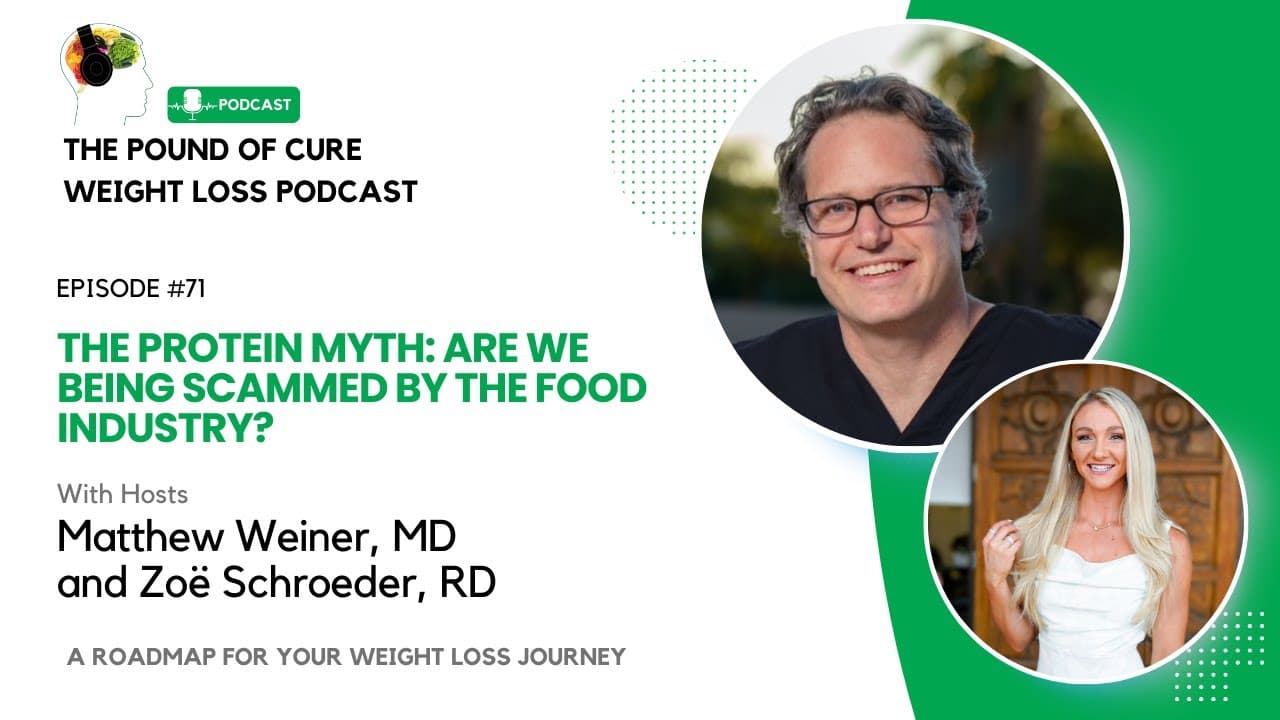
Episode 71: The Protein Myth: Are We Being Scammed by the Food Industry?
Episode Overview
In this episode of the Pound of Cure Weight Loss Podcast, Dr. Matthew Weiner and registered dietitian Zoë tackle three important topics affecting weight loss patients today. They discuss how artificial intelligence is transforming healthcare and nutrition support, explore whether the food industry's protein obsession is misleading consumers, examine groundbreaking research on metabolism and exercise, and address celebrity comments about GLP-1 medications like Ozempic.
AI Advances in Healthcare and Nutrition
Talk with our team
Have questions about this episode?
Send our Tucson weight loss team a note about bariatric surgery, GLP-1 medications, nutrition, or your next step with Pound of Cure.
More from this episode
Sage AI Dietitian Gets Smarter (00:20-04:34)
Dr. Weiner opens the episode by sharing exciting news about the Sage AI Dietitian in the Pound of Cure smartphone app. The team recently upgraded the system to GPT-5, and the improvement was dramatic.
Previously, the AI struggled to differentiate between bariatric surgery patients in their first three months versus those who were six months or a year out. This was concerning because someone who had a gastric sleeve a week ago should not be eating chicken, but Sage sometimes gave inappropriate advice.
After upgrading to GPT-5, the model immediately started answering correctly without any additional programming work. The new version is much better at understanding instructions and using tools to search the database for information like surgery dates.
Dr. Weiner explains that Sage is not just regular ChatGPT. The team has incorporated all of their algorithms, books, and videos to shape it into the Pound of Cure approach. If you ask the same questions on regular ChatGPT, you will get very different answers than what Sage provides.
For patients who are in their first three months post-op, Dr. Weiner encourages testing the system but recommends double-checking any concerning advice with a dietitian like Zoë or a physician.
The Future of Accessible Healthcare
Dr. Weiner describes himself as a technology enthusiast who writes computer code and has become obsessed with AI. He sees amazing potential for artificial intelligence to fix the broken healthcare system. This is exactly what the Pound of Cure team is trying to accomplish with their new smartphone app.
The Protein Industry: Following the Money
How Much Protein Do You Really Need? (04:43-10:12)
Zoë presents an article from the New York Times titled "Protein is Remaking the Food Economy. How much do you really need?" The article explores how protein obsession has taken over the food industry, visible in grocery stores with protein-enriched snacks and products everywhere.
Scientists recommend about 54 grams of protein per day for a 150-pound person. This translates to approximately one gram of protein for every 2.75 pounds of body weight. This recommendation is lower than what Zoë typically suggests to patients, and even lower than Dr. Weiner's usual recommendations.
According to the article, the typical American is now overeating protein by about 55% for men and 35% for women. A common misconception is that extra protein gets stored as muscle or muscle-building components. In reality, excess protein gets converted to energy and ultimately stored as fat if you consistently overeat it.
The Whey Protein Profit Machine
Dr. Weiner emphasizes the importance of following the money when evaluating dietary recommendations. The article does an excellent job of this with protein.
When companies make cheese or yogurt, they produce a byproduct called whey. For decades, manufacturers threw this whey away or fed it to livestock. Then the industry realized they could take this whey, which is rich in protein, and turn it into protein shakes and protein bars.
This product they were already throwing away became a profit center. The industry has tripled the profit from whey protein since the early 2000s. Dr. Weiner compares it to someone offering to pay you 50 dollars for your garbage. You would obviously keep it coming.
Today we see whey isolate in protein popcorn, protein water, cheese-flavored powder additives, and countless other products. First came the profit opportunity, then the marketing program, and finally it pervaded diet culture until high protein consumption became accepted as fact.
Nuanced Protein Recommendations for Different Situations (10:12-13:19)
Both Dr. Weiner and Zoë agree that protein recommendations are highly nuanced and depend on individual circumstances.
Zoë explains situations where higher protein intake is appropriate:
- Recently had bariatric surgery
- Currently taking a GLP-1 medication during acute weight loss phase
- No longer in honeymoon period but regularly lifting weights with a goal to build muscle
Someone building muscle definitely needs more than 54 grams of protein per day. The key question is whether we can shift focus away from processed, whey-enriched products toward whole food protein sources, particularly leaner options.
Anecdotally, patients who increase their protein from what might be considered adequate to around 80 grams often report feeling more satisfied with less hunger and fewer cravings. This does not apply to everyone, and the increased satisfaction might also come from additional fiber or other factors. However, if higher protein helps someone feel satisfied and succeed with weight loss, that is an important consideration.
Human Adaptability and Essential Amino Acids (11:12-13:07)
Dr. Weiner points out that humans are omnivores with remarkable adaptability. Some populations, like the Inuit people, live almost exclusively on fish with very little plant food or carbohydrates. They maintain fairly disease-free lives with reasonable health.
Other populations in Africa live almost entirely on yams and root vegetables as their primary calorie source.
Human beings can convert carbohydrates into protein, protein into carbohydrates, and carbohydrates into fat. Even if you do not eat 54 grams of protein, you may still get enough protein to build muscle by converting carbohydrates to protein. Our bodies are incredibly sophisticated.
Dr. Weiner questions the concept of essential amino acids (there are nine of them). These are amino acids we supposedly must eat because we cannot produce them. His theory is that essential amino acids may not be as essential as we have been taught. He suspects we probably can create them, but we simply do not know the pathway yet.
Many of these studies came from research on TPN (intravenous nutrition). When amino acids are injected intravenously, they may truly be essential. But when we eat protein, processing through the liver and other organs may allow us to manufacture these amino acids.
Dr. Weiner acknowledges this is his theory and that we do not definitively know the answer. He notes that nutrition science is a young field, making these questions difficult to answer with certainty.
The Reality of Nutrition Science (13:19-14:58)
Zoë explains that nutrition science and research is a young field. It is extremely hard to conduct high-quality scientific studies with nutrition and humans. You cannot lock people in a room and control everything they eat. Humans must eat, and they are unpredictable.
Dr. Weiner describes nutrition research as "blunt" compared to pharmaceutical research. In a randomized, double-blinded control trial for medication, you can sharply control which group gets the medication and which does not.
With nutrition, how do you take a thousand people and give 500 of them one exact diet and ensure they never break the rules, while the other 500 eat something completely different?
The landmark nutritional studies came from 1920 to 1950, before institutional review boards determined whether studies were ethical. The Minnesota Starvation Experiment is one example. Researchers had to do unethical things to get remotely scientific results.
This is why we simply do not know a lot about nutrition with certainty.
Protein Shakes: Perfect versus Better (15:45-17:05)
Dr. Weiner shares a story about a patient who worked with dangerous chemicals during the day. The man was coated in these chemicals and concerned about eating because he would ingest them. A protein shake seemed like the perfect lunch for him rather than grabbing fast food on the way home because he was starving.
Protein shakes will not make you score well on your calorie ratio. They are not perfect. But they are often much better than the alternative.
This reflects a fundamental value in the Pound of Cure program: not perfect but better. That is the goal.
Zoë emphasizes that nutrition exists on a spectrum. Over here might be perfect, and over there might be poor choices. If we can make small shifts toward the better end of the spectrum, those incremental changes will get us where we need to be.
Dr. Weiner does sell protein shakes in his office, acknowledging there is a role for them. But understanding the full picture helps patients make informed decisions.
Mind Over Milkshakes: The Power of Perception (17:35-18:52)
Zoë mentions a fascinating study where researchers gave two groups the same chocolate milkshake. They told one group it was a chocolate milkshake and the other group it was a nutritional protein shake. The participants actually metabolized it differently based on what they thought it was.
The study is titled "Mindsets, Not Just Nutrients, Determine Ghrelin Response." The mindset of indulgence produced a dramatically steeper decline in ghrelin (the hunger hormone) after consuming the shake. The mindset of sensibility produced a relatively flat ghrelin response.
Participants' satiety was consistent with what they believed they were consuming rather than the actual nutritional value.
Dr. Weiner finds this fascinating and plans to review the study. He believes it connects behavioral science to metabolic science, which he thinks is absolutely real. There is so much to learn from understanding how our thoughts affect our physical responses to food.
Metabolism Research: What Really Causes Obesity?
The Groundbreaking Cross-Cultural Study (19:01-22:08)
Dr. Weiner discusses an article from the Washington Post titled "What causes obesity? A major study is upending common wisdom."
Researchers used a radio-labeled compound to accurately measure metabolism across 34 countries. This cross-cultural study looked at Americans, hunter-gatherers, and many other populations to determine calorie expenditure throughout the day.
Dr. Weiner predicted the results before reading the study. He knew they would find no difference in calorie expenditure between active and sedentary people. People who walk 20,000 to 30,000 steps per day burn the same number of calories as people sitting all day.
This is because you basically burn the amount of calories that you eat. Dr. Weiner has weighed approximately the same for the last 10 years. If he eats 2,000 calories per day, that equals 2,000 times 365 days times 10 years, which is millions and millions of calories.
Somehow his body balanced the calories he took in versus the calories he burned exactly down to the last crumb. If you eat just 10 extra calories per day over a year, that equals 3,650 calories, which is approximately one pound (about 3,500 calories per pound). Over 10 years, that would be 10 pounds.
If you have not gained 10 pounds in 10 years, you have balanced what you ate and burned to within less than 10 calories per day. This is only possible if there is a feedback loop controlling it. We cannot consciously do this.
The Real Difference: Ultra-Processed Foods
The consensus of this study confirms that how much you move does not affect your calorie expenditure. However, the hunter-gatherers were all thin and the sedentary people were all overweight, even though they burned the same number of calories.
The real difference comes down to ultra-processed foods.
Zoë shares an example of a patient on vacation who ate extra food. When she returned home, she did not immediately resume her workout routine and had more sedentary days. However, she did not feel very hungry, so she did not eat as much.
This demonstrates how adaptable and smart our metabolisms are. The sedentary people in the study were overweight not necessarily because they felt more hunger, but because what they ate was ultra-processed and very calorically dense.
The Set Point Model and Constrained Energy Expenditure (25:51-26:46)
The article refers to the "constrained energy expenditure model." Dr. Weiner explains this is essentially what the Pound of Cure program calls the set point model. Your body regulates your metabolism.
This makes complete sense from an evolutionary perspective. Cavemen who starved to death did not pass on their genes. If you could not down-regulate your metabolism when food was scarce, you would not survive long.
As a species, we became very good at surviving on very few calories. This is why weight loss is so difficult. We are actually designed to survive without eating much and without losing too much weight.
Our bodies were designed to prevent weight loss. Now we struggle with weight gain and are encumbered by that evolutionary restriction.
Exercise and Weight Loss: Setting Realistic Expectations
Age and Exercise for Weight Loss (22:58-24:01)
Dr. Weiner states that exercise is a great form of weight loss if you are a woman under 30 or a man under 40. In that age group, exercise can help you lose weight.
Weight maintenance is a different story. Exercise is amazing for weight maintenance at any age. But for weight loss specifically, exercise becomes less effective as you age.
As you get older, you also get hurt more easily. When you get hurt, you often gain weight. These are important considerations.
Sometimes a 65-year-old patient comes in and says they really cannot exercise, so they guess they cannot lose weight. Dr. Weiner reassures them that they can absolutely still lose weight. It makes it a little harder, but exercise simply will not be the primary method.
The 90-10 Rule: Nutrition Drives Weight Loss (24:10-25:42)
The take-home message is that nutrition drives the majority of weight loss, while exercise drives weight maintenance.
We only have so much energy to dedicate to health improvements. If you are putting 50% of your energy into working out and 50% into nutrition, Dr. Weiner would recommend shifting that ratio dramatically toward nutrition. He suggests more like 90-10.
When someone comes into the office, Dr. Weiner does not start with exercise as a means of weight loss unless they are very young. Exercise is never the first step for weight loss in his approach.
However, exercise eventually becomes important, and for weight maintenance, it is priceless.
Zoë takes a slightly different approach. When working with people who are not exercising at all but are able to, she focuses primarily on nutrition for weight loss. But if possible, she likes to start increasing steps or adding a daily walk concurrently.
The goal is not necessarily to drive weight loss through movement initially, but to build the habit of moving your body daily. This way, patients can lean on that habit for weight maintenance without trying to form a new habit when they are no longer getting the positive feedback of weight loss.
Dr. Weiner agrees this approach is particularly useful for stress release and managing emotional eating. The mental health benefits of exercise are well documented, and they have discussed this in previous episodes.
Celebrity Commentary on GLP-1 Medications
The Bachelor Couple's Tone-Deaf Remarks (26:28-29:07)
The final article comes from People Magazine online. Sean and Catherine Lowe from The Bachelor television show stated that "the Ozempic craze is triggering and hard to watch" and that "there is a healthier route."
Zoë admits she does not know who these people are. Dr. Weiner explains they are from The Bachelor and are apparently married, making it a successful Bachelor connection.
Dr. Weiner finds the word "triggering" itself very triggering. He sarcastically apologizes that Sean and Catherine Lowe have to endure watching people who live real lives. These are people who go to work, raise children, may not have as much money and resources, do not have access to private chefs and Whole Foods grocery stores, do not have personal trainers, and do not have four hours a day to commit to their health routine.
If everybody had that much time and those resources, Dr. Weiner agrees we would see less obesity and perhaps less Ozempic use. But it is triggering to him that these people do not understand how the rest of the world lives.
Zoë calls the comments "tone deaf."
GLP-1 Medications Are Not the Easy Way Out (29:23-30:07)
One quote from Catherine Lowe particularly bothers both hosts. She warned that "society is often prone to taking the easy route."
Zoë emphasizes that she and Dr. Weiner talk with patients all the time. GLP-1 medications are not the easy way out. It is not for lack of patients trying other methods first.
Dr. Weiner argues that being on The Bachelor is actually the easy route. Getting married and becoming an Instagram influencer who receives free products in the mail sounds quite easy to him.
What really bothers both hosts is when naturally thin people judge people who are not naturally thin and who live different lives. Until you have walked a day in someone else's shoes, you should hold your judgment.
The Problem with Social Media Judgment (30:07-31:18)
Social media and news outlets make us quick to judge. We watch 30 seconds of someone behaving at their very worst and judge them as a terrible, awful human being. We want them to feel shame for those 30 seconds of misbehavior.
But we have all had 30 seconds of misbehavior. We all do things we wish we did not do and wish we were stronger about.
Dr. Weiner acknowledges the irony that he and Zoë are judging Sean and Catherine Lowe, but they are judging them for their lack of compassion and for judging others unfairly.
GLP-1 Medications Are Becoming Normalized (31:18-32:00)
Zoë notes that this type of negative commentary is becoming less common because so many people are now on GLP-1 medications. The treatments have become normalized, which is a good thing.
Why would we want strong negative opinions about something that is helping so many people?
A Near-Miracle Drug (32:00-32:43)
Dr. Weiner shares that patients often come into his office as perfect candidates for GLP-1 medications. These medications would address exactly what they are struggling with. The treatments would work well and provide numerous benefits, including improved blood pressure.
Then patients say they do not want to do "those Ozempic shots" because they have heard so many bad things.
These medications are the closest thing Dr. Weiner has seen in his entire career, and probably ever will see, to a miracle drug. There is so much good that can come from them and so much happiness and quality of life they can bring.
We need to keep judgment out of this discussion so that people who are suffering can feel relief without feeling like they are less of a human being. Their success should not be seen as less honorable, less valuable, or less earned.
We need to let people succeed and let them be proud of themselves without judging them.
Episode Conclusion
Zoë concludes that the world would be so much better if we were all lifting each other up rather than trying to tear each other down. Dr. Weiner agrees this is a good note to end the podcast on.
This episode covered important ground on AI in healthcare, the truth about protein needs versus food industry marketing, metabolism research that challenges exercise assumptions, and the ongoing need to support patients using all available tools for weight loss without judgment.
Weight loss topics covered in this episode
This conversation is part of the Pound of Cure approach to evidence-based weight loss education, including bariatric surgery, GLP-1 medications, nutrition counseling, metabolic health, and long-term patient support.
For more context, explore our guides to GLP-1 medications, bariatric surgery in Tucson, and the Metabolic Reset Diet.