Podcast Summary
Episode Overview
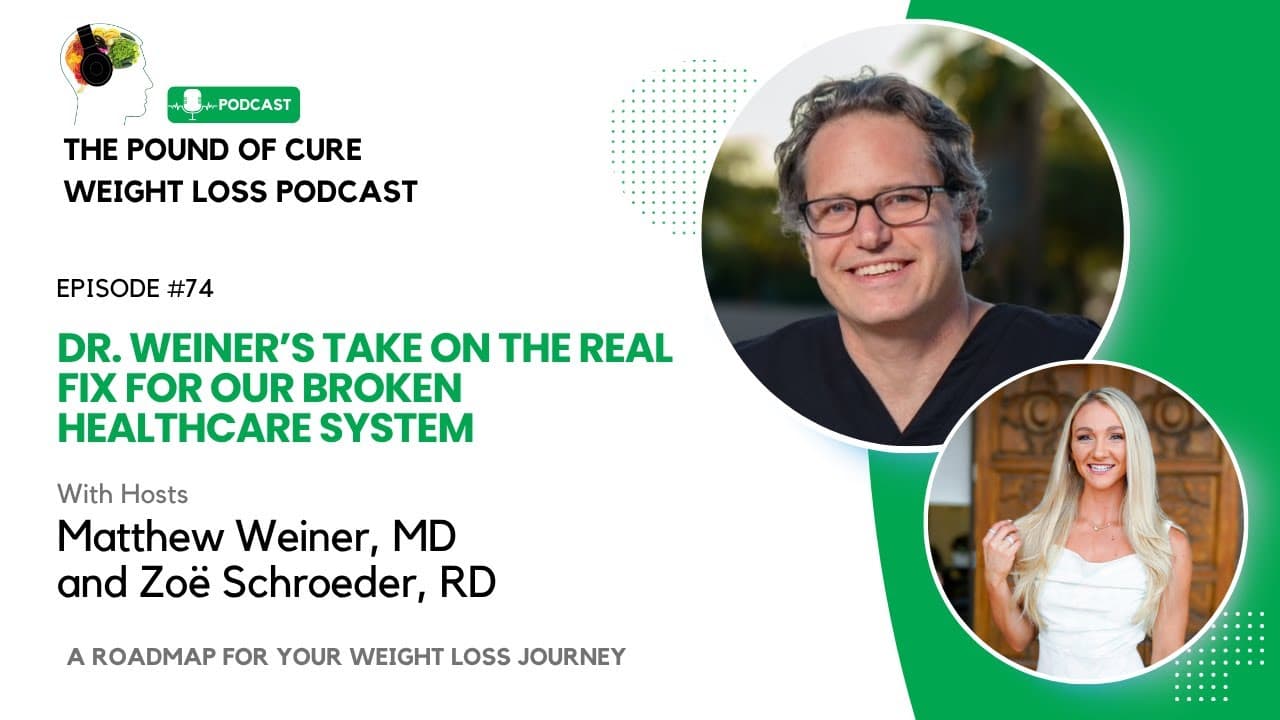
In Episode 74 of the Pound of Cure Weight Loss podcast, Dr. Matthew Weiner and Zoë discuss major changes happening in healthcare, particularly around obesity treatment and GLP-1 medications. Dr. Weiner makes a bold prediction that the current U.S. healthcare payment system could collapse by 2030, and explains why that might actually be good for patients. The episode covers exciting new data showing obesity rates declining for the first time in decades, the Trump Rx program for obesity medications, and answers listener questions about losing additional weight after bariatric surgery and managing celiac disease alongside weight loss surgery.
Personal Updates and Recipe Sharing
The episode opens with Zoë sharing that she is recovering from injuries and preparing for a half marathon. Dr. Weiner reveals he ran three marathons back in medical school but emphasizes that the secret to exercise is not getting hurt. As you get older, avoiding injury becomes more important than being in peak shape.
Talk with our team
Have questions about this episode?
Send our Tucson weight loss team a note about bariatric surgery, GLP-1 medications, nutrition, or your next step with Pound of Cure.
More from this episode
Dr. Weiner shares a quick and affordable recipe he made with his wife that cost about $20 from Trader Joes. They sauteed chicken breast and pre-cut broccoli together with olive oil, then added soy sauce, salt, nutritional yeast (which tastes like Parmesan), and peanut butter. The result was a Thai-style peanut butter chicken and broccoli dish that took only 20 minutes to make and is completely Pound of Cure approved.
Trump Rx Program and Obesity Medication Access
Dr. Weiner discusses breaking news about Trump Rx offering obesity medications like Wegovy and Zepbound at approximately $350 per month. While details are still unclear, this represents a significant shift where the government is negotiating directly with pharmaceutical companies, something that has been essentially forbidden in the past.
Every other country uses their buying power to negotiate with pharmaceutical companies, but the U.S. has not done this, which is one main reason drug prices are so high here. The fact that medications costing $5 to manufacture are being sold for $1,100 is described as absurd, comparable to suddenly having to pay $20 to drive down your own street.
The program may extend access to Medicare and even Medicaid patients, though this will require passing a federal law. Since the fen-phen era, federal law has prohibited Medicare from covering obesity treatment and obesity medications. Passing this law will require a majority vote in a politically divided system, which has proven difficult.
Dr. Weiner emphasizes that any conversation about price in medicine is positive because healthcare costs are out of control, hidden, and lack transparency. At Pound of Cure, the practice is working toward making sure every single patient knows exactly what they will pay before receiving care.
Prediction: Healthcare Payment System Collapse by 2030
Dr. Weiner makes a bold prediction that the current financial payment system for healthcare, including Cigna, United, Blue Cross, Aetna, and Medicare Advantage plans, will not survive through the rest of this decade. He believes that by 2030, the U.S. will not have a functioning traditional insurance payment system.
While this sounds dramatic, Dr. Weiner argues this could actually be a good thing because the current system creates no pressure for hospitals, pharmaceutical companies, doctors offices, and nursing facilities to provide higher quality care at lower cost. In fact, the current system financially rewards poor quality care. Dr. Weiner notes that if he doubled his complication rate as a surgeon, he would make more money because treating complications pays significantly more than performing perfect surgeries with no issues.
As a small business, Pound of Cure buys health insurance for employees, and premiums increased 25 percent in just one year. Dr. Weiner gave his employees a raise to cover this increase rather than passing it on to them. He believes this 25 percent jump in one year indicates the system has passed the tipping point.
Doctors are increasingly leaving insurance networks, meaning patients pay $1,000 to $1,200 per month for family coverage but cannot find doctors who accept that insurance. This clearly shows the money is not going where patients need it to go, which is to the physicians providing their care.
First Decline in U.S. Obesity Rates
Zoë presents exciting data from Vox showing that for the first time since obesity rates have been recorded, the U.S. is seeing a meaningful decline. Self-reported obesity rates dropped from 39.9 percent (essentially 40 percent) in 2022 to 37 percent in 2025. This is the first decline ever recorded.
The article shows that in 2024, 6 percent of Americans were using GLP-1 medications. Just one year later in 2025, that number doubled to 12 percent of U.S. adults. Dr. Weiner predicts that when medication costs come down further, usage will double again.
Dr. Weiner emphasizes that obesity is 100 percent treatable. Patients who weigh 500 pounds can live at half that weight through the combination of medications and surgery working together. However, approximately 15 percent of people do not respond to GLP-1 medications, which is devastating for those patients. Some people respond well to one medication but not another, though this is not common. Often if someone does not respond to Wegovy, they also will not respond to Zepbound. The question remains whether having five different drugs available would increase response rates by five times, which is currently unknown.
Impact on Childhood Obesity
Zoë raises an interesting question about whether declining adult obesity rates will have a ripple effect on childhood obesity. If adults are losing weight, this may change household environments, food availability, eating patterns, and how families interact with physical activity, potentially reducing childhood obesity without children needing to take medications themselves.
Dr. Weiner points out that GLP-1 medications are contraindicated in pregnancy and nursing, primarily due to concerns about neural tube defects, though the data supporting this concern is very flimsy. These medications stay in the body for a long time, so the current recommendation is to stop taking them before trying to become pregnant.
Many women taking GLP-1s become pregnant unexpectedly because fertility increases with weight loss. This creates an opportunity to study pregnancies that occurred while women were taking GLP-1s right up until conception. In five to ten years, researchers will be able to examine childhood obesity rates in children born to mothers who were on these medications.
The epigenetics of this situation is fascinating. It remains to be seen whether GLP-1 medications prevent obesity genes from being turned on in children and how maternal and paternal DNA changes from weight loss impact fetal development.
The Dietitian Perspective on GLP-1 Medications
Dr. Weiner asks Zoë how GLP-1 medications have changed her practice as a registered dietitian and what other dietitians are saying about these drugs.
Zoë explains that initially there was hesitation due to the unknown, similar to the hesitation she had about bariatric surgery before working with Pound of Cure. Now that she works with patients and sees how life-changing these treatments can be, her perspective has completely shifted.
Some hesitation still exists among online health coaches and fitness influencers, though these medications are sometimes glamorized when marketed as peptides, especially when these influencers can make money selling them. However, registered dietitians who maintain rigid personal biases against GLP-1 medications are becoming out of touch, given that usage doubled in just the past year.
The key is helping patients use these medications as tools to change lifestyle habits and create sustainable results. Unlike phentermine, which is somewhat scary and not something dietitians love to see patients using, GLP-1s are genuinely changing the game and opening up important conversations about how to support patients effectively.
Zoë finds it exciting to mentor other dietitians and lead discussions about how to help patients on GLP-1 medications, enabling these professionals to better serve their clients.
Why GLP-1s Increase the Need for Dietitians
Dr. Weiner points out that traditional lifestyle-only approaches have extremely low success rates for long-term weight loss. Many patients work with every fiber of strength they have, lose 10 percent of their body weight, and then gain it back within six months in the classic yo-yo dieting pattern. This makes being a lifestyle-only dietitian very frustrating.
Bariatric surgery dramatically increased the need for dietitians because there is a right way and a wrong way to eat after surgery. The same is true for GLP-1 medications. Many people think they can just use portion control, but Dr. Weiner believes the same portion control trap that exists with bariatric surgery also exists with GLP-1s.
Taking a GLP-1 medication actually increases your need for a dietitian rather than replacing that need. It makes nutrition more challenging to figure out, not less. Patients need guidance on what to eat to maximally leverage the effects of these drugs and ensure sustainable weight loss. If you are spending significant money on these medications, working with a dietitian helps you get the most out of that investment because everyone responds differently and needs individualized support.
Pound of Cure App Development for GLP-1 Users
Dr. Weiner shares that in 2026, Pound of Cure is working to improve their app specifically for people on GLP-1 medications. The goal is to help patients understand exactly what they should do to get the most out of these drugs using both AI technology and human-guided support from registered dietitians.
While the current app is good, the team is working to make it great. This is critically important because while tens of thousands or even hundreds of thousands of nutrition books have been written over the years, including Dr. Weiner's own book, anything written before 2024 is probably irrelevant for people on GLP-1 medications.
The GLP-1 diet has not been clearly defined yet, making this a wide open space. Dr. Weiner believes his nutritional program is well-suited for this because it was originally designed for bariatric surgery. Both bariatric surgery and GLP-1 medications work through the same hormonal mechanisms, so the same nutritional approach applies. Dr. Weiner stands by his program as the best diet for people taking GLP-1s.
Zoë agrees that there is tremendous overlap in how the metabolism responds to both treatments. Many patients who had bariatric surgery and later go on a GLP-1 say it reminds them of their honeymoon period after surgery, and the nutritional approach should be used the same way.
Question 1: Losing Additional Weight After Gastric Bypass
A listener from Facebook asks about losing an additional 20 pounds after having gastric bypass three years ago. They lost 80 pounds and have maintained their weight at 173 pounds for at least a year. At 5 feet 3 inches tall, they are grateful for the procedure and their health has improved immensely, but they do not feel the way they thought they would in their new body and want to lose more weight. They specifically state they do not want to take a GLP-1 medication.
Dr. Weiner identifies this person as transitioning from the honeymoon period to the end of the honeymoon period after surgery. This is a natural change that happens to everyone.
The first step is using the calculators available on the Pound of Cure website (which will also be shared on Instagram) to predict expected weight loss based on factors including age, gender, whether you have diabetes, and whether you take psychiatric medications. Dr. Weiner suspects this person lost exactly what would be expected based on their starting weight of approximately 250 pounds.
Dr. Weiner used to tell patients that whatever lowest weight they hit after surgery would be the lowest weight for the rest of their life. He no longer says this because of GLP-1 medications. However, if someone does not want to use GLP-1s, that statement still generally holds true.
Zoë focuses on body composition rather than scale weight. If this person could stay at 173 pounds but have a more toned physique with less body fat and more muscle, would they feel great in their body? Coming out of the honeymoon period is actually an excellent opportunity for body recomposition because rapid weight loss has stopped and the person can eat a bit more to build muscle.
Zoë would explore whether strength training could be added to the routine. She would also audit current eating habits and lifestyle factors, looking for opportunities to increase activity, implement the metabolic reset diet if needed, identify any weight regain or old habits returning, and make small incremental changes.
For example, if the person works a desk job and does not exercise much, adding movement sprinkles throughout the day provides mental breaks from screens, reduces stress, and improves sleep, which overall supports health and potentially helps weight drop further. Other tweaks might include food swaps or improving hydration if water intake decreased after the early post-surgery period when hydration was heavily emphasized.
Dr. Weiner recommends gratitude journaling for this person. Humans naturally focus on what they do not have rather than what they do have, which is why social media is so popular. This person lost 80 pounds but is putting most of their mental energy into the 20 pounds they did not lose rather than celebrating the 80 they did lose. Reframing this perspective is something within their control.
However, if this person truly wants to lose 20 more pounds, the realistic answer is GLP-1 medications, probably at a low dose. Dr. Weiner would never ramp this person up to the highest dose of Zepbound, but starting at 2.5 milligrams combined with working with a dietitian to dial in lifestyle factors and build muscle might achieve that 20-pound loss.
The decision this person faces is not simply whether or not to take GLP-1s. The real decision is: do you not want GLP-1s, or do you want to lose 20 more pounds? Those are the two options. Whichever choice feels best is valid because it is your body and your choice, but recognizing the realistic parameters of that decision is important.
Question 2: Managing Celiac Disease After Bariatric Surgery
A listener from YouTube was recently diagnosed with celiac disease and finds the restrictions overwhelming. They had gastric bypass three years ago and lost 89 kilograms (approximately 200 pounds), which is tremendous success. They want advice for managing celiac disease specifically.
Zoë explains that the metabolic reset diet works very well for people who are gluten-free because it eliminates grains and focuses on whole foods. While not necessarily low carbohydrate, it emphasizes high quality, complex, fiber-rich carbohydrate sources along with other metabolic reset aligned foods.
The Pound of Cure app, which is free to download, allows for individualization through Sage, the AI feature. Users can ask questions like asking for a meal plan that follows the metabolic reset diet but is also celiac-friendly. Users can also update their food preferences in the app to indicate gluten-free, which ensures all recipes, meal plans, and recommendations are tailored to their specific nutrition needs.
Dr. Weiner adds that there are variable levels of how gluten-free someone needs to be. For example, Ketel One makes gluten-free vodka, which implies other vodkas contain gluten, though in microscopic amounts. Not that anyone should regularly consume vodka, but this illustrates that trace amounts of gluten exist in many products.
Some people are extremely concerned about even the tiniest amounts of gluten, which makes diet very restrictive. Working with whoever diagnosed you with celiac disease to determine your tolerance for small amounts of gluten is important. Avoiding anything with even microscopic gluten doses is extremely difficult, but avoiding bread and foods with wheat as a primary ingredient can reduce gluten exposure from 95 percent down to very low levels.
For some celiac patients this is adequate, for others it is not. The difference between eating bread versus consuming something with trace gluten amounts will impact someone with celiac disease very differently. True celiac disease confirmed by biopsy as an autoimmune disorder is relatively uncommon, while sensitivity or intolerance to the gluten protein is extremely common. Understanding where you fall on that spectrum helps determine how strictly you need to avoid gluten and what your upper threshold is.
Weight loss topics covered in this episode
This conversation is part of the Pound of Cure approach to evidence-based weight loss education, including bariatric surgery, GLP-1 medications, nutrition counseling, metabolic health, and long-term patient support.
For more context, explore our guides to GLP-1 medications, bariatric surgery in Tucson, and the Metabolic Reset Diet.