Podcast Summary
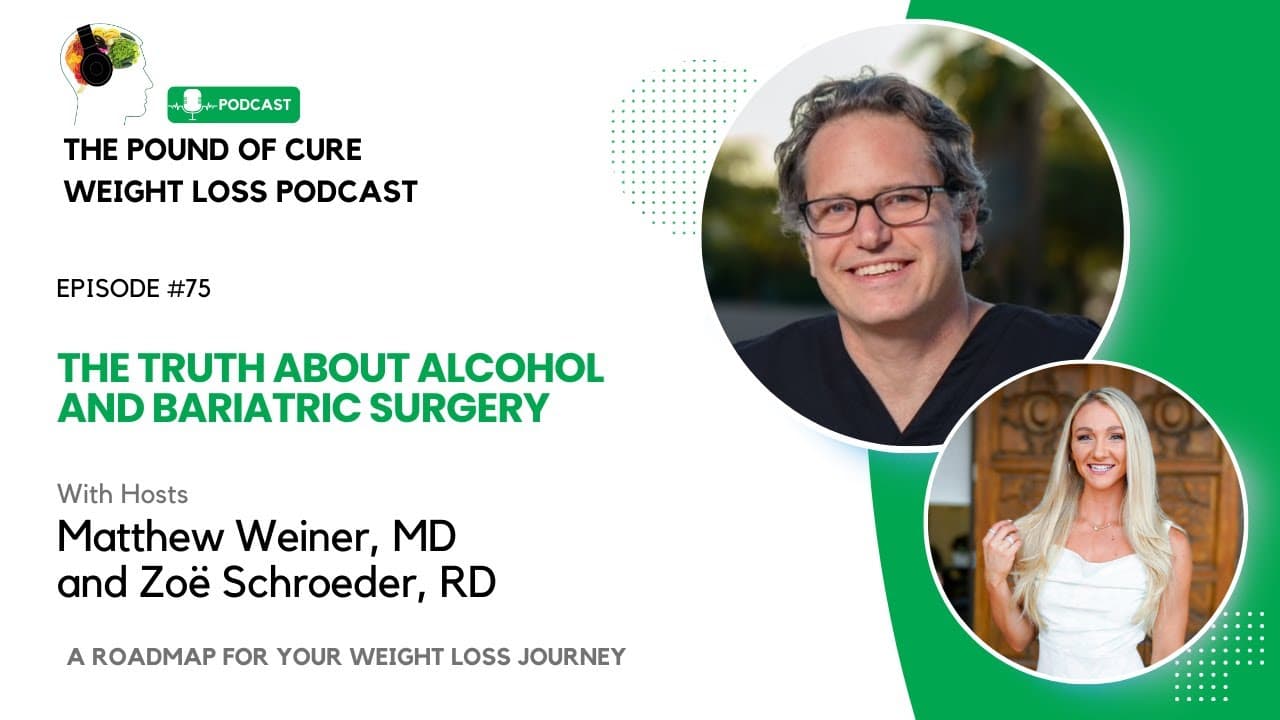
Episode 75: The Truth About Alcohol and Bariatric Surgery - Complete Guide
Overview
In this episode of the Pound of Cure Weight Loss Podcast, Dr. Matthew Weiner and nurse practitioner Deidre Schodroski answer common patient questions about life after bariatric surgery. While much of their recent content has focused on GLP-1 medications, this episode returns to surgical topics, covering marginal ulcers, hiatal hernias, alcohol metabolism after gastric bypass, and the challenging early recovery period.
Dr. Weiner and Deidre work as a surgical team in Tucson, Arizona. Deidre assists in the operating room and manages patients throughout their surgical journey, bringing valuable long-term patient care insights to every procedure.
Talk with our team
Have questions about this episode?
Send our Tucson weight loss team a note about bariatric surgery, GLP-1 medications, nutrition, or your next step with Pound of Cure.
More from this episode
Question 1: Upper Abdominal Pain After Gastric Bypass (0:43)
The Patient Question
A patient who had gastric bypass five years ago reported constant upper abdominal pain after eating, persistent nausea, good eating habits, adequate water intake, and only taking a multivitamin and Excedrin Migraine for headaches.
The Likely Diagnosis: Marginal Ulcer
Deidre explains that this presentation strongly suggests a marginal ulcer at the connection between the stomach and intestine, called the gastrojejunal anastomosis or GJ anastomosis. The culprit is likely the Excedrin Migraine, which contains aspirin, an NSAID that gastric bypass patients must avoid completely.
NSAIDs After Gastric Bypass: The Complete List
After gastric bypass, patients can no longer take any NSAIDs, including:
- Ibuprofen
- Motrin
- Aspirin
- Naproxen
- Celebrex
- Mobic
- Toradol
Many migraine medications and cold and flu remedies contain hidden NSAIDs. Excedrin Migraine contains aspirin, though a Tylenol-based version is now available and safe for gastric bypass patients.
Other Ulcer Risk Factors
Beyond NSAIDs, marginal ulcers can develop from:
- Cigarette smoke exposure
- Marijuana smoke
- Vaping
- Alcohol use
- Steroid medications
Treatment for Marginal Ulcers
Most ulcers respond well to medical treatment over one to two months:
- Pantoprazole: A proton pump inhibitor that many bypass patients already take after surgery to suppress acid production
- Second antacid: Either misoprostol or famotidine, which suppresses acid through a different pathway
- Coating medication: A drinkable medication that coats the anastomosis to protect the ulcer from food and allow healing
Crucially, patients must also stop the underlying cause, whether NSAIDs, tobacco smoke, or alcohol.
Why Gastric Bypass Causes Ulcers (6:21)
Dr. Weiner explains the fundamental anatomy problem. The stomach is very acidic, then releases bile, which is alkaline (the opposite of acidic). Different parts of the intestine are designed to tolerate different pH levels.
With gastric bypass, surgeons connect an acid-intolerant segment of small intestine directly to the stomach, which releases acid. This creates ulcer risk, though it affects a relatively small percentage of patients.
Most stomach acid is produced in the lower stomach, not the upper pouch. Patients who produce more acid in the upper stomach face higher ulcer risk. Older surgical techniques created much larger pouches, producing more acid and higher ulcer rates. Modern small pouches mean less acid and lower ulcer risk.
Surgical Revision for Ulcers (6:04)
Dr. Weiner and Deidre have performed 50 to 60 GJ revisions for ulcers, seeing patients from across Arizona. These are challenging surgeries that can take considerable time. The key factor determining difficulty is gastric pouch size.
If the pouch is large enough, surgeons can work around the ulcer to create a new pouch and connection with healthy tissue. Deidre recently saw three revision patients at different post-operative stages, all doing fantastic with improved quality of life and comfortable eating.
The Danger of Delayed Treatment (7:39)
Dr. Weiner recently consulted on a hospital case illustrating the end stage of untreated ulcers: a 130-pound patient bounced between doctors, unable to eat due to a large ulcer, now suffering severe malnutrition. Early intervention is critical because severe malnutrition must be corrected before revision surgery can even be attempted.
Key Takeaway
Ulcers are treatable problems requiring lifestyle changes (avoiding NSAIDs, alcohol, and tobacco smoke), plus timely intervention by a surgeon experienced in revision procedures. If you experience problems after gastric bypass, contact your bariatric surgeon immediately rather than letting issues progress. Gastric bypass is not a forgiving surgery and requires following the rules.
Question 2: Hiatal Hernias and Bariatric Surgery (10:13)
The Patient Question
A patient was told during bariatric evaluation that they have a small hiatal hernia and have suffered bad acid reflux for years. They want to know if this affects surgery, whether the hernia should be repaired during weight loss surgery, if reflux will improve or worsen, and whether hernias can recur.
Deidre notes they see this scenario about ten times every day.
What Is a Hiatal Hernia? (10:43)
The diaphragm is the muscle between chest and abdomen that allows breathing. In the middle is a hole called the hiatus where the esophagus passes through to reach the stomach.
In some people, this muscle is weak and the hole becomes too large. Abdominal pressure is higher than chest pressure, pushing the stomach up through the hiatus. The stomach becomes stuck above the diaphragm in the chest.
Hiatal Hernia Symptoms
The most common symptom is reflux. Other symptoms include:
- Dyspepsia (indigestion)
- Bloating
- Difficulty eating
- Feeling like food gets stuck when swallowing
- Esophageal spasm (painful contraction of esophagus and stomach muscles)
Why Hiatal Hernias Are Common in Obesity
Hiatal hernias develop from increased abdominal pressure in obesity. Some people are also born with diaphragms that have less structural integrity, with thin and fragile tissue. Risk also increases with age.
Diagnosing Hiatal Hernias (12:00)
Many patients know about their hiatal hernia from endoscopy performed by their gastroenterologist. However, endoscopy assessment is somewhat subjective because the camera views the inside of the esophagus while the hernia (the hole in the diaphragm) is on the outside. This makes it difficult to accurately measure hernia size.
During bariatric surgery, surgeons directly visualize the hernia and make real-time decisions about repair necessity.
Repair Decisions: Sleeve vs. Bypass (12:49)
With gastric sleeve, surgeons almost always fix hiatal hernias because sleeve anatomy increases reflux risk. Dr. Weiner's practice has adopted a mesh technique using very small amounts of absorbable mesh, which disappears over time.
Dr. Weiner feels more comfortable with absorbable mesh because revision surgery with permanent mesh still in place is extremely difficult, complicated, and much higher risk than traditional hiatal hernia repair. He has only performed a few such revisions, and they were challenging cases.
With gastric bypass, surgeons are more selective because bypass is inherently an excellent anti-reflux surgery. Since bypass eliminates reflux through its anatomy, hernia repair may be unnecessary.
The "While You're In There" Fallacy (13:54)
Dr. Weiner warns against the grocery store mentality of combining procedures. Doing less in the operating room is better. The idea of picking up extra procedures while the surgeon is already operating does not hold up.
He uses a stark example: you would not ask a surgeon to remove half your pancreas while taking out your gallbladder, because removing half the pancreas is an extremely severe and morbid surgery. The "one surgery, might as well do it all" approach can lead to bad decisions and poor long-term outcomes.
Trust Your Experienced Surgeon (14:54)
Deciding whether to fix a hiatal hernia is sophisticated and nuanced. Surgeons who have performed thousands of procedures develop expertise in these decisions. Dr. Weiner notes that having Deidre involved in long-term patient management provides valuable perspective on outcomes with and without hernia repair.
Hiatal Hernia Repair Outcomes (16:00)
Outcomes are usually very good. Most patients do not experience more difficult recovery than without hernia repair.
Can Hernias Recur?
Yes, especially after sleeve. Deidre recently saw a patient who had sleeve with mesh hernia repair about a year ago. Recent endoscopy due to terrible reflux showed hernia recurrence and severe erosive esophagitis (inflammation of the esophagus from reflux).
Good treatment for this patient would be conversion from sleeve to bypass, which eliminates reflux, possibly with hiatal hernia repair depending on anatomy.
Managing Recurrent Hernias with Mesh (16:45)
When mesh is present from prior repair, the safest approach is often simply revising to bypass without redoing the hernia repair. This achieves 90 percent of reflux improvement with only 10 percent of the risk compared to redoing a mesh repair.
Dr. Weiner emphasizes that hiatal hernias are manageable and solvable. They rarely see patients with hiatal hernias they cannot fix. Repair almost always gets patients into good shape with significantly improved quality of life.
Question 3: Alcohol After Gastric Bypass (18:27)
The Patient Question
A patient three months out from gastric bypass asked if it is okay to have one drink at Thanksgiving.
Dr. Weiner's Strong Position on Alcohol
Dr. Weiner feels very passionate about this topic and prioritizes patient education. He points to his 500 YouTube videos as evidence of his commitment to informed decision-making.
Bariatric surgery is a permanent anatomical change. Patients trust that this decision will improve their health. These surgeries are not perfect, have side effects, and complications can occur, though they tend to be treatable.
The Risk: Alcoholism After Gastric Bypass
There are few things worse than being 100 pounds overweight, and Dr. Weiner believes alcoholism is one of them.
With gastric bypass specifically, he does not believe this is transfer addiction (replacing food with alcohol). Instead, alcohol hits the brain differently because it passes directly through the stomach into the small intestine, is rapidly absorbed, and creates different alcohol absorption curves than before surgery.
How Alcohol Works Differently Post-Bypass
Alcohol after gastric bypass acts like an intravenous drug. Before surgery, drinking takes about 20 minutes before effects set in. After gastric bypass, alcohol hits immediately, rises quickly, and can come down quickly.
These rapid changes in blood alcohol levels are more addictive. The published rate of alcoholism after gastric bypass is 4 percent.
The Math of Risk
Dr. Weiner's practice performs about 200 gastric bypasses per year. If they do not do everything possible to prevent alcoholism, they would be creating eight new alcoholics every year. Year after year, that accumulates to a significant number.
The Only Safe Recommendation
The only way to absolutely prevent this devastating complication is zero alcohol. Never drinking means zero percent risk.
If this patient chooses to ignore the recommendation, has one drink in a controlled setting, understands the risks, talks to family about it, and makes absolutely certain it is only one drink, they will probably be okay. But the best advice is to never drink.
Special Risk for Non-Drinkers (21:36)
Dr. Weiner almost worries more about patients who were total non-drinkers before surgery because their guard is down. They never worried about alcohol intake before and may not recognize developing problems.
Deidre counsels all patients to be aware of risks and strictly limit any alcohol consumption.
The Legal Limit Warning (22:02)
Especially in women, one alcoholic beverage can put you over the legal limit for driving. If you have lost significant weight, the effect is even worse.
The absolute rule: zero alcohol with driving after gastric bypass.
Question 4: Struggling in the First Week After Surgery (22:29)
The Patient Question
A patient who had gastric bypass last Tuesday reported struggling with water that does not taste right and is hard to drink, exhaustion with protein shakes, and feelings of regret, asking what they are doing wrong.
You Are Doing Nothing Wrong
Deidre hears this frequently and reassures patients: you are not doing anything wrong. The first week can be rough. Gastric bypass is a huge adjustment to the body.
The Hormonal Revolution (22:57)
There is massive hormonal change in the gastrointestinal system, which affects hormonal pathways throughout:
- The brain (hypothalamus)
- Lower small intestine
- Pancreas
- Reproductive hormones
- Pretty much every system in the body
Dramatic Changes in Taste and Smell
Because of these hormonal changes, taste changes dramatically. Patients get full fast, stay full longer, everything tastes 100 times sweeter, and even smells are different.
Deidre saw a comment asking why nobody talks about taste and smell changes after gastric bypass. One example: patients ask why their feet smell. They do not smell. The patient had a bypass and everything is 100 times more intense for at least three to four months.
Common Food and Drink Aversions
Fifteen percent or more of patients can no longer drink plain water. Patients stop liking things they loved before surgery. They cannot drink protein shakes that are too sweet or too thick, even if they drank them daily before surgery.
The good news: it gets better with time. Even by the end of the first week, people feel significantly better than the first few days. Once patients start soft foods and return to a routine, head hunger is satisfied by eating something, making a huge difference. By three to four months, most people are in a very good routine.
Hydration Is Most Important (24:49)
The biggest priority after surgery is hydration. You have plenty of protein stores. If you do not get all your protein immediately, which most people cannot because there is not room for both fluid and protein, you will not become malnourished in the first week or two.
However, if you do not get enough fluid, it only takes a day or two before you feel terrible: nauseous, headaches, dizzy. Then you really do not want to drink because you feel bad, so you just want to sleep.
Solutions for Hydration Problems (24:54)
You can drink anything you want that is sugar-free, as long as it is not carbonated. If you cannot drink water, keep trying different things until you find something you like, then stick with it.
Options include:
- Fruit-infused water
- Unsweetened tea
- Bottled water (bypass patients are very particular, sometimes preferring specific brands over tap water)
- Coffee
- Powerade Zero
- Whatever works for you
Staying hydrated is the most important thing.
Solutions for Protein Shake Problems (25:45)
When artificial sweeteners and sweetness in protein shakes become intolerable, make whole fruit shakes using:
- Greek yogurt
- Milk
- Fruits
- Vegetables
Deidre refers patients to Sage, the AI dietitian in the Pound of Cure app. Patients can ask Sage: "I had a gastric bypass, I want to make a whole food smoothie with 30 grams of protein. Give me 10 recipe ideas." Sage provides answers in 30 seconds.
This approach avoids processed pre-made shakes that were tolerable before surgery but are now 100 times too sweet.
The Power of Trial and Error (26:12)
Dr. Weiner emphasizes that if something does not work, try something else. Dilute drinks down. The brain has powerful ability to determine what we will tolerate before we eat it. This is nutritional intelligence humans evolved as hunter-gatherers, allowing us to take a tiny bite of a poisonous berry and recognize we should not eat more.
Pay close attention to your body and taste signals. Get creative and try different things.
The big mistake is rigidly following the surgery practice list exactly as written. Modify and adjust based on what you feel you will tolerate.
Regret Is Incredibly Common (27:02)
Patients are often afraid to talk about regret because saying it out loud makes it real. Dr. Weiner acknowledges this is incredibly common in the first week.
Deidre would not say half of patients experience regret, but it is a huge adjustment. Because of hormonal changes, patients are also very emotional after major surgery. Mood swings are very common. People get into a cycle of worrying what is wrong, feeling depressed, and developing anxiety about food.
All of this gets better. Talk to your provider about it. Dr. Weiner, Deidre, and the team can walk you through solutions. Inevitably by three to four months, as everything settles down, people feel so much better. At one year, patients say they are so glad they did the surgery and cannot believe they ever thought they made a mistake.
Why Regret Does Not Last (27:59)
The important message: regret does not last.
Dr. Weiner explains another factor. Calorie deficit alone causes depression. In his first book, he discussed the Minnesota starvation experiment, where researchers restricted calorie intake as part of a study and rates of depression went through the roof.
When you get very few calories, a starved brain is not just slow or dull, it is depressed. Getting enough calorie intake is important, which is where homemade smoothies help because they tend to be quite high in calories. That is actually a plus at the early post-surgery stage.
Vitamins and Emotions (28:48)
Deidre adds that homemade smoothies are also high in vitamins, which is important because vitamin deficiency can also affect emotions.
About the Practice and Resources (29:06)
Dr. Weiner and Deidre's practice is located in Tucson, Arizona. They see people from all over the Southwest and beyond.
They have developed a smartphone app called Pound of Cure featuring an AI dietitian named Sage. The team is working to make this a great resource for anyone trying to lose weight, whether through GLP-1 medications, bariatric surgery, or nutrition, providing the absolute best support possible.
The app is available for free download on the Google Play Store and iOS App Store for comprehensive weight loss support and guidance.
Weight loss topics covered in this episode
This conversation is part of the Pound of Cure approach to evidence-based weight loss education, including bariatric surgery, GLP-1 medications, nutrition counseling, metabolic health, and long-term patient support.
For more context, explore our guides to GLP-1 medications, bariatric surgery in Tucson, and the Metabolic Reset Diet.