Podcast Summary
Episode Overview
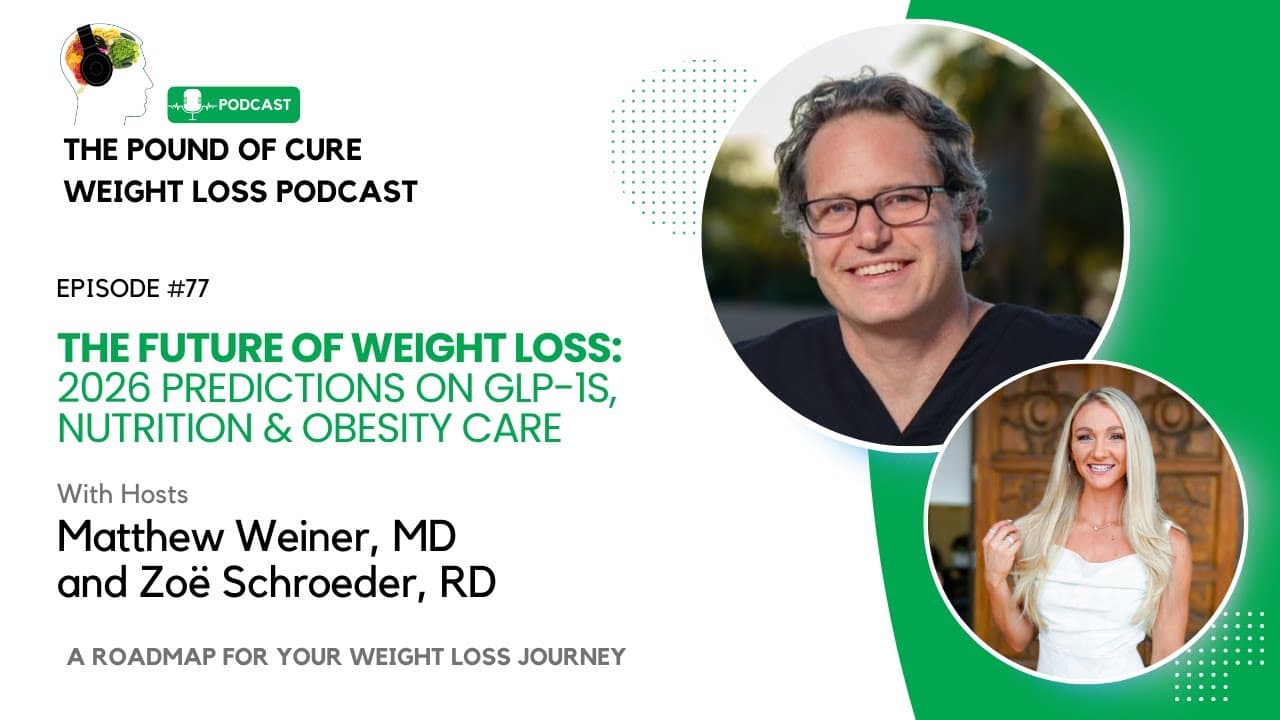
In this special annual predictions episode, Dr. Matthew Weiner, registered dietitian Zoë, and Deidre review their weight loss predictions from 2025 and share evidence-based predictions for 2026. The team discusses the future of GLP-1 medications, bariatric surgery, nutrition strategies, and how obesity care is rapidly evolving. This episode offers patients practical insights into what to expect in weight loss treatment over the coming year.
Reviewing 2025 Predictions
FDA Approvals and Insurance Coverage
Talk with our team
Have questions about this episode?
Send our Tucson weight loss team a note about bariatric surgery, GLP-1 medications, nutrition, or your next step with Pound of Cure.
More from this episode
The team predicted that expanded FDA approvals for sleep apnea, fatty liver disease, and cardiovascular conditions would not meaningfully improve insurance coverage. They got this prediction wrong. Deidre reports that coverage actually did improve, especially for Medicare Advantage patients with sleep apnea. Several private insurance plans also picked up expanded coverage for lower BMI values.
Wagovy's approval for fatty liver disease (with moderate fibrosis shown on a FIB-4 test) has led to more approvals than the previous cardiovascular disease criteria. Looking ahead to 2026, expanded coverage for renal disease and moderate cardiovascular diseases is expected, particularly for Medicare and Medicare Advantage patients.
AI-Powered Meal Planning
The prediction that AI-powered meal planning would become standard across commercial weight loss programs partially came true. The Pound of Cure app features Sage, an AI dietitian that patients use primarily for meal planning. Patients report success using Sage to generate recipe ideas based on available ingredients, like frozen scallops and specific pantry items.
While not all patients are using the AI meal planning feature, those who take time to personalize it find it helpful. Dr. Weiner notes that AI meal planning is a fast way to get patients started on the Pound of Cure program without needing to spell out every detail. The team plans to improve the app in 2026 to make meal plans more easily referenced and to help with accountability.
Flexible GLP-1 Dosing Strategies
The team predicted that rigid stepwise GLP-1 dosing would become less strict. This prediction has largely proven true within their practice, but not widely adopted elsewhere.
Deidre explains the standard dosing approach: manufacturers recommend increasing GLP-1 medication doses every month because that was the protocol used in initial approval studies. However, this does not mean monthly increases are better for weight loss or side effects. The Pound of Cure practice uses a slower schedule of increasing doses every two to three months, which both decreases side effects and produces more significant weight loss.
The majority of weight loss happens at initial doses when the body is naive to the medication. Rushing through these doses means patients lose less weight overall and experience more side effects. Slower dosing gives the body time to acclimate. The practice has even started a microdosing program using smaller increments than the standard 2.5 milligram increases.
Dr. Weiner emphasizes that with creative dosing strategies, particularly using vials, patients can start GLP-1 medications with essentially zero side effects. Many people believe nausea, constipation, and abdominal bloating are unavoidable punishments for being overweight, but this is not true. With the right approach, the experience should not be uncomfortable.
This flexible dosing strategy remains rare in primary care and endocrinology, which is why seeing an obesity specialist is so important.
Retatrutide Cardiovascular Concerns
Dr. Weiner predicted that retatrutide would raise cardiovascular safety concerns. This triple agonist medication from Eli Lilly targets GLP-1, GIP, and glucagon receptors. Glucagon has been linked to cardiovascular events, raising questions about whether a glucagon agonist might cause problems even as weight loss provides cardiovascular protection.
Retatrutide is finishing stage three trials in early 2026, with approval expected by early 2027 (six to ten months after trials complete). Dr. Weiner expresses skepticism about whether Eli Lilly will be forthcoming with safety details given the medication's potential as a $100 billion product. This prediction may not play out until after 2026.
GLP-1 Specific Products
The final 2025 prediction was that GLP-1 specific support products would explode in popularity but be largely useless. This prediction came true. The market has seen protein shakes, supplements, frozen meals, and various products marketed specifically for GLP-1 users.
Zoë emphasizes that sticking with whole, real, unprocessed foods remains better for most people than any specifically branded GLP-1 product. The team agrees this prediction was accurate.
2026 Predictions
Protein Quality Over Quantity
Zoë predicts a shift toward protein quality mattering more than protein quantity. The current market is saturated with highly processed protein products, from protein cheddar dust for popcorn to protein water and protein Pop-Tarts.
When patients shift from multiple daily protein shakes to whole food protein sources, they feel more satisfied even with the same 30 grams of protein per meal. Real food provides more nutrients, and the body knows what to do with it, helping lower set point more effectively.
Deidre notes that the fitness and bodybuilding space has influenced weight loss recommendations, but bodybuilders needing 300 grams of protein daily have different needs than people focused on weight loss. Many highly processed protein products like protein donuts and cookies still contain high amounts of fat, carbohydrates, and added sugar. Patients would get better nutrition from a real cookie plus a separate protein source.
Interestingly, bodybuilders in late-stage competition prep often remove processed protein shakes and artificial sweeteners, relying on whole food protein sources like chicken and broccoli because their bodies perform better.
Dr. Weiner adds that protein source matters. Plant protein is the highest quality, though getting 80 grams daily from plants is challenging. Next are lean animal proteins like salmon, chicken, and turkey (ideally organic). Processed protein supplements rank lowest in the hierarchy.
Oral GLP-1 Medications
Deidre predicts that oral GLP-1 medications will not be as good as injectables, though they may cost less. Two pill forms are coming in 2026.
Novo Nordisk is releasing a 50 milligram semaglutide pill in early January 2026, priced at $199 per month. This is a higher dose than the existing Rybelsus pill (which produces only 8 to 10 percent weight loss and causes significant nausea). The new pill includes an added protein to slow stomach absorption, aiming for 15 to 17 percent weight loss similar to Wegovy.
However, oral medications must pass through the liver and stomach, losing efficacy. Deidre expects the new pill will still cause significant GI side effects and may not match injectable weight loss results.
Eli Lilly is releasing Orforglipron at the end of 2026, a GLP-1/GIP combination like Zepbound but in pill form. Without the absorption-slowing protein, weight loss is expected to be only 8 to 12 percent with similar nausea issues.
Oral medications also have strict timing requirements: no food or drink for two hours before, only water for 30 minutes after. This affects absorption and makes the medications harder to take correctly, potentially leading to reduced results and more side effects.
Dr. Weiner notes that historically, pharmaceutical companies believed pills would always be preferred over injectables. However, with weight loss medications, patient experience may matter more than delivery method. People will choose the medication that makes them feel best, causes fewest side effects, and produces the most weight loss, regardless of whether it is a pill or injection.
The lower-cost pills may be ideal for patients wanting to lose only 10 to 15 pounds or those who lost insurance coverage and need maintenance dosing. Some patients might use injectables for weight loss and switch to pills for maintenance.
Bariatric Surgery Shifts
Dr. Weiner predicts bariatric surgery will be performed as outpatient procedures and that the pendulum will shift back toward sleeve gastrectomy from gastric bypass.
A few years ago, sleeves dominated because they are less invasive. Then surgeons shifted toward bypass due to weight regain after sleeves. Now the trend is moving back toward sleeves because combining sleeve surgery with GLP-1 medications is proving to be a powerful combination for the right patient (someone without acid reflux).
The typical Pound of Cure strategy is to start patients on medications. If they respond well but need to lose more than the 15 to 20 percent achievable with medications alone, a sleeve is added to bolster weight loss.
Endoscopic sleeve gastrectomy is also gaining traction. Cigna recently agreed to cover it, and the national obesity care society has endorsed it as an official weight loss surgery. Dr. Weiner has endoscopic sleeve patients doing well on GLP-1s, suggesting that combining less invasive endoscopic procedures with medications may become more common.
Fiber Marketing Overhaul
Zoë predicts fiber will receive the same marketing attention that protein currently enjoys. While protein has dominated the weight loss and wellness conversation, fiber is equally important for weight loss, weight maintenance, and overall health.
Major news sources like NPR are already publishing articles about the importance of combining fiber and protein. Fiber is not just Metamucil for constipation. It plays a crucial role in weight loss, gut hormones, and the gut-brain axis.
However, Zoë expects the same problem that occurred with protein: processed fiber supplements will be marketed as equivalent to whole food fiber sources. Low-carb tortilla wraps containing 14 grams of added fiber are not the same as 14 grams of fiber from broccoli (which would be approximately eight cups).
Fiber from whole foods is nature's GLP-1. High-fiber vegetables and fruits fill the stomach with large volume, creating fullness. The body works hard to break down whole food fiber, causing delayed gastric emptying similar to GLP-1 medications. Ultra-processed fiber products cannot replicate this effect.
Deidre notes that fiber affects the balance of GI and gut hormones connected to weight loss through the gut-brain axis, making it far more important than just a constipation remedy.
GLP-1 Cost Reductions
Deidre predicts GLP-1 medication costs will drop significantly in 2026. Self-pay injectable costs are expected to reach approximately $250 per month, with expanded access to generic GLP-1s driving competition.
Recent changes include Wegovy dropping to $349 per month (with various specials running) and plans to decrease another $100 in 2026. Eli Lilly dropped to $449 and is expected to reach $349 in the first half of 2026.
The most exciting development is generic GLP-1s launching in multiple countries, particularly Canada. Generic pricing is expected to be 70 to 80 percent lower than the current $996 per month ticket price, bringing costs down to approximately $200 per month. Four companies are competing in this space.
As competition intensifies and new medications launch, prices will continue falling. This is critical because more employers are dropping GLP-1 coverage annually due to high costs increasing premiums. More patients will enter the self-pay market, which is becoming increasingly reasonable compared to early 2025.
Dr. Weiner notes that compounding is now the most expensive option, with some patients paying $600 to $700 when real medication costs $450. Some compounded products are being branded as superior, which is misleading.
The team believes less insurance coverage will ultimately lead to more affordable and accessible medications. GLP-1s cost only $5 to $10 per month to manufacture, leaving room for profit at lower prices. With creative dosing strategies cutting costs by a third, patients could routinely access these medications for under $100 per month within the next year.
Nutrition on GLP-1s
Dr. Weiner predicts the importance of good nutrition while taking GLP-1s will become more frequently discussed. The conversation has been dominated by access and response, losing focus on the fact that combining medications with lifestyle changes produces the best results.
The same portion control trap seen with bariatric surgery (eating one less piece of pizza) occurs with GLP-1s. The medications are tools, just like surgery. GLP-1s with lifestyle changes provide the real rocket fuel for weight loss.
Dr. Weiner proposes an interesting theory: when patients start GLP-1 medications, their brain shifts and their set point lowers. During the first month or two, some patients naturally avoid carbohydrates, others avoid fats, and others turn toward nutrient-dense diets. This may reveal metabolic secrets about which diet works best for each individual.
If someone's body pushes them toward vegetables and fruit when starting medications, they are probably a nutrient-dense diet person. Paying attention during this initial period can help identify the optimal diet approach.
Deidre sees some patients who cannot tolerate salads or vegetables after starting medications, becoming more protein-focused. She uses Sage in the Pound of Cure app during every visit to help patients generate meal ideas: "I'm on a diet, I don't like this or this, but I'm craving protein, give me 10 breakfast ideas that will help me lose weight and not give me heartburn." This opens patients' minds to eating what their body is telling them while avoiding the same repetitive meals.
The whole food diet approach is the most effective way to avoid side effects and achieve the best weight loss. Deidre sees the portion control trap constantly, with patients saying they ate half a breakfast burrito as if that ensures weight loss. The medication is a tool; without proper nutrition, patients will not feel good or lose much weight, and may even gain weight at higher doses.
Zoë emphasizes the need for more mindfulness and awareness to tap into what the body is communicating about food choices. Most people eat mindlessly or while distracted, making it hard to notice these signals. Providing guidance on reflection could help patients optimize their food choices based on how their body responds.
Weight Loss Maintenance
Zoë predicts the maintenance phase of weight loss will become its own specialty or receive significantly more attention. This is a huge gap in the current obesity care space.
Deidre agrees that medications have made weight loss more accessible to a much larger percentage of the population compared to bariatric surgery. Many more people are now reaching their goal weight and asking, "What do I do with my medication? How do I eat now?"
Traditionally, diets end with "goodbye, good luck" after reaching goal weight, leading to yo-yo weight regain because the approach was not sustainable. Whatever lifestyle changes are used to lose weight must continue long term to maintain the loss. Steps, vegetables, water, and other habits do not stop when the weight comes off. Forming long-term habits is essential.
Dr. Weiner notes that he cannot recall seeing studies specifically about weight maintenance. If you asked ten obesity specialists how they handle weight maintenance, you would get ten different answers. There is no consensus and little science guiding medication management during maintenance. Nutrition is underrepresented in maintenance plans. This is an area that must be sorted through as it becomes increasingly important.
Deidre emphasizes that medications and surgery help control hunger and cravings. This is the time to learn healthful eating patterns. As patients lose weight, they can become more active, make better choices, and build healthy habits needed for maintenance. The medication effect will lessen during maintenance, but if patients are already in the right mindset and routine, they can automatically maintain their weight loss. Lifestyle changes cause weight loss; the medication allows patients to make those changes.
Personalized Nutrition and Weight Loss Tools
Deidre predicts an explosion in personalized nutrition tools including continuous glucose monitors (CGMs), body composition tools like smart scales and DEXA scans, personalized labs for nutrition and weight loss, and AI integration.
CGMs are already appearing as self-pay options at much lower costs. More offices are offering advanced body composition testing. Advertisements for personalized nutrition labs are increasing. These tools will connect to help people become more involved in their personalized weight loss experience.
This addresses a missing element in past weight loss approaches: fad diets that are not right for everybody, making them ineffective and unsustainable. Personalized data gives people ways to see progress and stay motivated.
There are downsides. Some patients become obsessed with CGM numbers without understanding how blood sugars work or what the fluctuations mean. Similar issues can occur with body composition data.
Zoë is excited about at-home body composition scales that sync to phones. Looking at trends in fat mass, skeletal muscle, and body water helps explain daily weight fluctuations. If someone went out to eat and had extra sodium, the scale shows increased body water, not fat gain. This additional data helps people detach emotionally from the single weight number and heals relationships with the scale.
Deidre agrees this addresses the problem of people feeling like failures when weight increases a couple pounds, even though water weight alone can cause five-pound daily fluctuations. Understanding this through data provides non-scale victories and prevents tying success only to an inaccurate scale number.
Zoë adds that this prevents the number from dictating actions or emotions for the day, avoiding destructive responses like eating whatever you want because the scale went up, or skipping breakfast and doing extra hard workouts. Both responses are wrong.
Bariatric Surgery as Second-Line Treatment
Dr. Weiner predicts bariatric surgery will officially become the second-line treatment for obesity. As medication costs decrease, surgery will be reserved for people who do not respond to weight loss medications or who have 40 to 50 percent of total body weight to lose (when medications only achieve 20 to 25 percent loss and surgery is needed to close the gap).
Dr. Weiner welcomes this change despite identifying primarily as a bariatric surgeon. He embraced medications initially to support bariatric patients, and the practice grew from there. He enjoys working with patients on medications.
Currently, when patients request weight loss surgery, he tries to determine how to get them on medications first. Often they are already on medications or have already tried them. Medications become the first-line approach, and response to medications dictates surgical choice. Non-responders lean toward gastric bypass, while responders who need to lose more weight than medications provide are candidates for sleeve or endoscopic sleeve.
Surgery sits behind medications as the second line. Dr. Weiner does not expect a huge decrease in bariatric surgery volume in 2026 because of this shift, partly due to ongoing medication access issues.
Deidre notes there is an increased role for medications after surgery, which was not popular for a long time. Medications are even more effective for poor responders after surgery than before surgery. Studies now show this benefit for both sleeve and bypass patients.
Dr. Weiner considers bariatric surgery weight regain to be a historical issue that is no longer a real problem in their practice unless patients cannot access medications. Looking at 2026 trends with increasing medication access, bariatric surgery weight regain is treatable and no longer the concern it once was.
AI in Obesity Care
The team's joint prediction is that obesity care focused on GLP-1s will be the first medical specialty where AI provides meaningful care.
Dr. Weiner finds this obvious for several reasons. Weight loss has already been delegated to digital tools like MyFitnessPal. Most weight loss programs now operate online with apps, food tracking, and other digital features.
The current healthcare system is failing doctors, patients, and employers who pay for it. Nobody is happy except large corporations. This is happening simultaneously with AI development.
While AI could theoretically do primary care or other specialties, those areas carry significant risk. Missing chest pain that leads to a heart attack has serious consequences. GLP-1 obesity care provides a very low-risk space. GLP-1s are incredibly safe; even accidental overdoses at four, five, or six times the normal dose are miserable but do not cause hospitalization or permanent damage.
The space where people are already comfortable working online, with a large safety window, and prescribing that follows algorithms makes obesity care ideal for AI integration. The Pound of Cure app may soon suggest dose increases.
Dr. Weiner sees enormous potential for AI to begin providing meaningful care in this specialty before expanding to higher-risk areas of medicine.
Key Takeaways for Patients
The future of weight loss and obesity care in 2026 will bring lower medication costs, increased access, more personalized tools, and greater recognition that medications are tools requiring nutrition and lifestyle changes for optimal results. Patients should expect to see continued evolution in how GLP-1 medications are prescribed, dosed, and combined with other treatments. Working with obesity specialists who use flexible, patient-centered approaches will become increasingly important as the field rapidly advances.
Weight loss topics covered in this episode
This conversation is part of the Pound of Cure approach to evidence-based weight loss education, including bariatric surgery, GLP-1 medications, nutrition counseling, metabolic health, and long-term patient support.
For more context, explore our guides to GLP-1 medications, bariatric surgery in Tucson, and the Metabolic Reset Diet.