Podcast Summary
Episode Overview
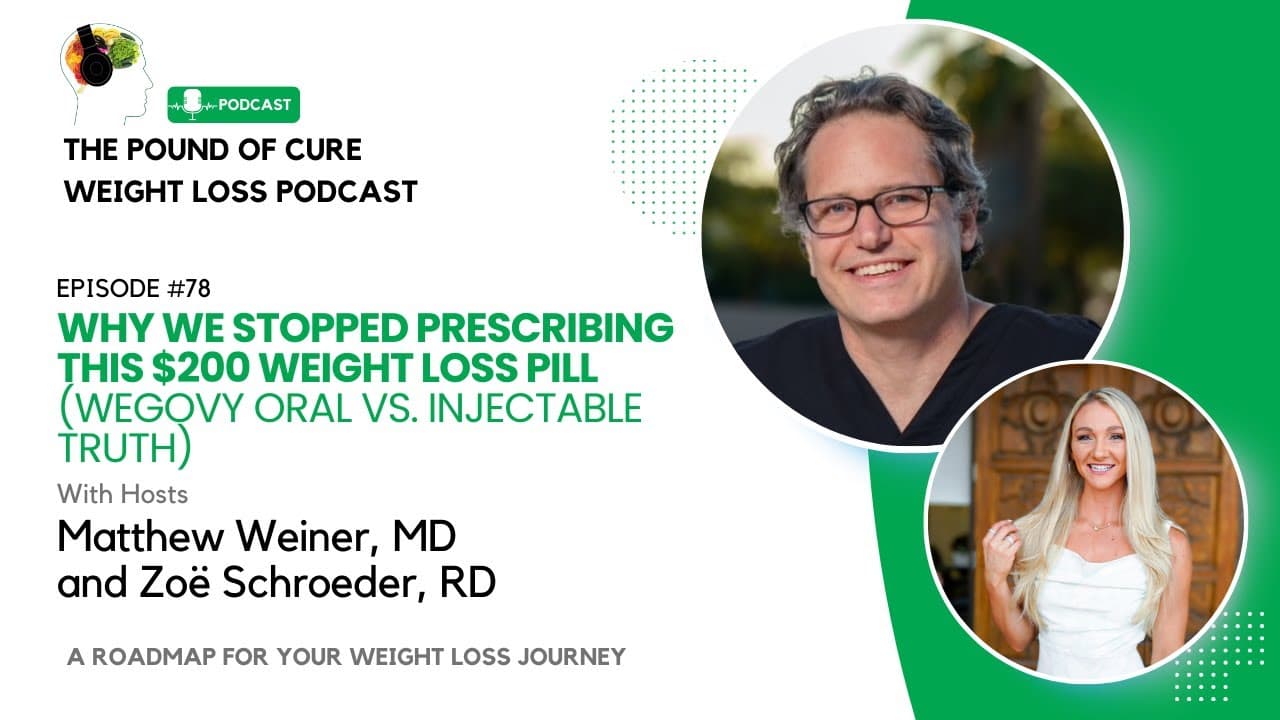
In Episode 78 of the Pound of Cure Weight Loss Podcast, Dr. Matthew Weiner and Zoe discuss their decision to stop prescribing the new oral Wegovy pill, the reality that it is actually a five-year-old medication, and what patients need to know about its effectiveness compared to injectable GLP-1 medications. The episode also covers their social media challenges after being hacked, a major pivot toward YouTube and Reddit, and exciting updates about their new app for affordable weight loss care.
Social Media Hack and Practice Pivot (00:20-10:08)
The episode opens with acknowledgment of a major setback. Pound of Cure lost their entire Facebook and Instagram presence to hackers. Dr. Weiner's Facebook page, which he maintained for over 10 years, was completely taken over and shut down. Instagram is also gone, and the team does not expect to recover either account.
Talk with our team
Have questions about this episode?
Send our Tucson weight loss team a note about bariatric surgery, GLP-1 medications, nutrition, or your next step with Pound of Cure.
More from this episode
Dr. Weiner views this challenge as the universe redirecting their efforts. He has never felt comfortable on Instagram or Facebook because their approach to weight loss requires more than 30-second soundbites. He sees patients for extended consultations, not 60 patients in a day, and believes that meaningful weight loss conversations demand nuance and context.
The practice is pivoting hard toward YouTube and Reddit. Dr. Weiner explains that YouTube allows for the long-form content their methodology requires. Reddit appeals to him because of its upvoting system, which elevates thoughtful, helpful content and buries trolling behavior. He appreciates that Reddit fosters consensus-building and respectful disagreement, unlike the tribalistic negativity often found on other platforms.
Zoe agrees that their content has always performed better in long-form formats. Years of consistent effort on Instagram and TikTok never led to meaningful engagement. The hack, while frustrating, may ultimately prove to be the tipping point that shifts the practice toward platforms better suited to their educational mission.
New App for Affordable, AI-Powered Weight Loss Care (10:08-15:06)
Dr. Weiner reveals that he has been a software developer longer than he has been a physician. He loves creating systems, and the Pound of Cure set point methodology is built on a concrete, repeatable strategy that any provider can learn.
He describes a recurring experience in his practice. Patients arrive with intense self-blame, believing their weight gain is entirely their fault. Through careful history-taking, Dr. Weiner pieces together the actual causes. He identifies medications like tamoxifen for breast cancer, periods of immobilization from injuries, and other factors completely beyond the patient's control. By the end of the visit, he can account for nearly every pound of weight gain. This process relieves patients of years of unwarranted guilt.
Dr. Weiner's lifelong goal has been to systematize this approach so it can reach more people. With advances in artificial intelligence, he is building a new version of the Pound of Cure app that replicates what he does in the office. The app will systematically evaluate weight gain history, past struggles, successes, and failures. It will identify root causes and recommend treatments, including GLP-1 medications and bariatric surgery.
The new app aims to provide expert care at a transparent, affordable cost. In a healthcare system where a single doctor visit can cost $800, the app will offer on-demand access to providers like Dr. Weiner and Zoe. Dr. Weiner believes patients will be able to see a provider through the app faster than they could get a human being to answer the phone at most doctors' offices.
The app will use Cali Ratio technology and incorporate significant AI-powered features. The team is actively seeking beta testers and will also offer an affiliate program for those interested in promoting the app. Zoe has tested the new version and describes it as incredibly user-friendly and intuitive. Users will have a natural conversation with the algorithms, making the process of accessing care streamlined and efficient.
Why They Stopped Prescribing the Oral Wegovy Pill (15:06-22:41)
Dr. Weiner addresses the buzz around the new oral Wegovy pill, which has been marketed as a revolutionary alternative to injections. The pill costs less than $200 per month, with starting doses around $149. However, Dr. Weiner clarifies that this medication is not new. It is semaglutide in oral form, the same active ingredient found in Ozempic and Wegovy injectables. This oral formulation was released about five years ago as Rybelsus for the treatment of diabetes.
Pound of Cure has been prescribing Rybelsus for years. Over time, the practice has phased it out because patients did not respond nearly as well as they did to injectable forms. Dr. Weiner's clinical experience shows that oral semaglutide produces less weight loss and more gastrointestinal side effects compared to injections.
Zoe notes that the oral version requires daily dosing, while injections are administered at most once per week. This difference in frequency can affect adherence and how personally patients relate to their medication. Dr. Weiner emphasizes that the relationship patients develop with their GLP-1 medication is deeply individual. He has patients who respond far better to semaglutide than to tirzepatide (Zepbound), even though tirzepatide generally shows stronger data. The format of the medication, whether pill or injection, matters less to most patients than the effectiveness, side effects, and how the medication fits into their lifestyle.
Dr. Weiner predicts that the oral Wegovy pill will result in more side effects and less weight loss than injectables. His theory, based on the set point model, is that a less effective medication at a lower dose will eventually cause the set point to creep up, leading to weight regain. However, he acknowledges that theories require data, and he will need more time and patient experience before offering definitive guidance on when oral formulations might be appropriate.
Zoe raises the possibility that a lower dose of oral semaglutide might serve as a long-term maintenance strategy after initial weight loss with injectables. Dr. Weiner agrees this is worth exploring but notes the practice has not yet tried this approach. He expects individual conversations with patients will determine the best strategies over time.
Orforglipron is another oral GLP-1 formulation expected later in 2025. Dr. Weiner is not opposed to oral medications in general, only to this specific drug based on his past experience. Every new drug and delivery method will be different, and more options will ultimately benefit patients by improving access and driving down costs.
Retatrutide: The Breakthrough Drug of 2026 (32:52-38:09)
A listener who participated in the retatrutide cardiovascular trial shares impressive results. They lost 37% of their body weight, with their BMI dropping from 36.2 to 22.5. They are now off all blood pressure medications, as well as cholesterol and thyroid medications, with no heart issues.
Dr. Weiner explains that retatrutide is the only medication currently in development that compares to Zepbound (tirzepatide). Early data suggests it may even be more effective. Retatrutide is a triple agonist, targeting GLP-1, GIP, and glucagon receptors. Semaglutide is a single agonist (GLP-1 only), while tirzepatide is a dual agonist (GLP-1 and GIP).
Glucagon is the opposite of insulin. Insulin promotes fat storage, while glucagon promotes fat burning. However, glucagon is similar to epinephrine and acts as a stimulant. Pure glucagon can cause cardiac events, so Dr. Weiner emphasizes the need to carefully evaluate cardiovascular outcomes in the retatrutide trials. He is not suggesting that retatrutide will cause heart attacks, but that rigorous scrutiny is necessary.
Because retatrutide produces significant weight loss and metabolic improvements, it may mask potential cardiovascular risks. Over time, researchers will need to compare cardiovascular risk reduction across semaglutide, tirzepatide, and retatrutide to determine which drug is best for which purpose. It is possible that semaglutide, despite being the weakest for weight loss, could be the best at reducing heart attack risk.
Dr. Weiner envisions a future where providers tailor GLP-1 medications, and possibly combine them, to address individual patient needs. Different drugs may be better for sleep apnea, fatty liver disease, cardiovascular risk, or weight loss. This personalized approach will be a major evolution in the field.
Dr. Weiner identifies retatrutide as the breakthrough drug of 2026. He expects it to take the market by storm, though insurance coverage and pricing will complicate adoption. If retatrutide launches with a competitive self-pay price, he predicts a massive shift toward it. Otherwise, adoption may be slower.
Zoe asks when retatrutide might become widely available. Dr. Weiner believes it will be soon, likely in 2026. The self-pay price will be a critical factor in determining how quickly patients can access it.
Lilly Direct High-Volume Vials: Real Medication for $150 Per Month (26:18-27:44)
Dr. Weiner discusses an affordable alternative to compounded GLP-1 medications. Lilly Direct now offers high-volume vials of tirzepatide (Zepbound) at $450 per vial. Through Pound of Cure's dilution program, patients can access this medication for $150 per month. This is the real product from Eli Lilly, not a compounded version.
Dr. Weiner states he can almost guarantee that patients currently using compounded medications are paying significantly more than $150 per month. He strongly recommends switching to the Lilly Direct product. It is the same medication, likely less expensive, and comes from a reliable source with verified quality and origin. Patients do not have to question its providence.
Patient Question: Bariatric Surgery Plus GLP-1 for Breast Cancer Weight Regain (24:32-28:05)
A listener had vertical sleeve gastrectomy (VSG) in early 2022 and lost about 45 pounds. In late 2022, she was diagnosed with breast cancer and underwent a double mastectomy along with multiple surgeries and medications throughout 2022 and 2024. She regained almost all of her weight. She started compounded tirzepatide in November 2024 and has lost 10 pounds. She is hopeful that the combination of her sleeve and the GLP-1 medication will help her reach her goals.
Dr. Weiner calls this a classic story. Sleeve patients commonly regain weight, which used to be a significant downside of the procedure. Now, with the availability of GLP-1 medications, sleeve weight regain is highly treatable. He describes this combination as easy to address, stating that GLP-1s are extremely effective for post-bariatric weight regain.
Dr. Weiner identifies the likely causes of her weight regain. The sleeve itself contributes to regain over time. The breast cancer diagnosis likely led to treatment with tamoxifen, a medication known to cause weight gain. The mastectomy, multiple surgeries, stress, and recovery downtime all contributed. He emphasizes that this weight regain was inevitable and beyond her control.
Dr. Weiner commends the patient for not blaming herself. He notes that her situation was entirely due to circumstances beyond her control. He also highlights an important additional benefit. While the evidence is still emerging, he believes GLP-1 medications will markedly reduce the risk of breast cancer recurrence. This makes her decision to start tirzepatide even more beneficial.
He advises her to switch from compounded medication to the real Lilly Direct product, which will likely be less expensive and more reliable. He encourages her to keep the podcast updated on her progress in the coming months and year.
Zoe adds that cancer prevention nutrition ultimately comes down to basics. The diet culture and wellness industry overcomplicate things. An anti-inflammatory, high-antioxidant diet consists of plenty of fruits and vegetables, minimally processed whole foods, limited added sugar, and limited sodium. This is the same foundation as the metabolic reset diet and applies to many medical nutrition needs, including diabetes, high blood pressure, and inflammation reduction. Eliminating processed foods and eating a high-produce diet is the core answer.
Patient Question: Home-Ground Flour and Ancient Grains (29:26-32:52)
A listener asks about the health benefits of freshly ground flour and replacing white flour breads with homemade versions. Zoe researched the nutritional differences and found that home-ground flour may offer slightly higher protein and fiber, but the differences are not dramatic. The main benefit is that it is less processed, and the person has full control over the ingredients.
Dr. Weiner shifts the focus to the type of grain used, which he considers more important than how the flour is ground. Mechanical grinding can only be done in a limited number of ways, and he compares it to asking whether a Ninja blender makes healthier smoothies than a Vitamix. Both blend the ingredients.
Modern wheat has been heavily modified. The tall amber waves of grain from historical imagery have been replaced by dwarf varieties that grow only knee-high. These dwarf grains are easier to harvest and process with less labor. However, this mutation has reduced fiber and protein content.
Dr. Weiner is far more interested in discussing ancient grains like quinoa, barley, and others that retain higher nutritional value. He recommends focusing on the grain itself rather than the grinding method.
Zoe agrees and notes that different flours offer different nutritional profiles. Quinoa flour provides higher protein than rice flour, for example. She also mentions that denser flours may require adjustments in baking, such as adding extra leavening agents like baking powder.
Patient Question: Flora Fiber Bars (38:09-42:27)
A listener asks for opinions on Flora fiber bars, developed by the creator of Jeni's Ice Cream. The listener tries to get fiber from whole foods and leafy greens but finds the Flora bars helpful.
Zoe reviews the nutrition facts. One bar contains 140 calories, 5 grams of fat, 28 grams of carbohydrate, 13 grams of fiber, 1 gram of added sugar, and 2 grams of protein. The ingredients include apple paste, chia seeds, pumpkin seeds, quinoa, prebiotic fiber, fermented watermelon rind, cantaloupe, honeydew, mango, pineapple, almond, chicory root inulin, apple concentrate, rice bran oil, cassava root syrup, vegetable juice for color, vanilla bean, natural flavor, salt, rosemary extract, and tea leaf.
Zoe notes that the ingredients are mostly whole foods, which is positive. However, she questions whether eating the bar provides the same satiety as eating the whole foods it contains. For example, eating two apples would likely be more filling than the apple paste in the bar. The bar is low in protein, which further limits its ability to keep someone satisfied.
A box of 10 bars costs $33, or about $3.30 per bar. Dr. Weiner suggests that patients could create a similar snack at home with applesauce, Greek yogurt, and chia seeds for about $10, yielding twice as much product. He acknowledges that the Flora bar is one of the better options in the bar category, but he prefers that patients make their own snacks when possible.
Zoe mentions RX Bars as another whole-food-based option. RX Bars use egg whites and nuts, providing more protein, though they contain less fiber than Flora bars. She notes that bars in general can be problematic, but those with natural, whole-food-based ingredients are better choices when convenience is necessary.
Dr. Weiner, as a DIY enthusiast who codes his own apps, reiterates his preference for homemade solutions.
Patient Question: Hiatal Hernia vs. Abdominal Wall Hernia (42:57-45:22)
A listener asks about a ball that forms every time they cough, which they push back down repeatedly. They are unsure if the problem has existed for a long time and symptoms are just now worsening.
This question came from a comment on one of Dr. Weiner's hiatal hernia videos. He explains that a hernia is a hole in a muscle layer that should be intact. A hiatal hernia occurs when the stomach slides into the chest through a hole in the diaphragm. The diaphragm cannot be touched or seen without making a large incision, so a hiatal hernia cannot be felt or observed from the outside.
Patients frequently tell Dr. Weiner they can see or feel their hiatal hernia bulging, but this is not possible. A hiatal hernia requires an imaging study to diagnose, such as an endoscopy, CT scan, or sometimes an ultrasound. It cannot be seen from the outside because it is too deep.
What the listener describes, a bulge that pops out and back in, is an abdominal wall hernia. There are many types, including inguinal hernias in the groin, umbilical hernias, epigastric hernias, xiphoid hernias, and incisional hernias. This type of hernia does require medical attention.
Dr. Weiner often tells patients that if a hernia does not bother them, it does not bother him. However, this statement is not universally true and requires careful evaluation. Abdominal wall hernias can incarcerate, meaning intestine can get stuck in them, which is a dangerous situation. A thorough history and thoughtful conversation are necessary before deciding to leave a hernia alone.
A hiatal hernia is different and is associated with acid reflux or food getting stuck. Dr. Weiner performs hiatal hernia surgery frequently. It is not difficult to diagnose, but it cannot be diagnosed on physical exam.
Closing Thoughts
Dr. Weiner and Zoe covered a wide range of topics in this episode, including politics, nutrition, GLP-1 medications, hernias, surgery, hacking, and software development. The episode offered a glimpse into Dr. Weiner's thought process and the multifaceted approach Pound of Cure takes to weight loss and metabolic health.
Since the practice is no longer distributing content on Instagram or Facebook, the team asks listeners to share the podcast with anyone who might find it helpful. They remain committed to showing up, diving into nuance, and having meaningful conversations to help people live healthier and happier lives through sustainable weight loss.
Weight loss topics covered in this episode
This conversation is part of the Pound of Cure approach to evidence-based weight loss education, including bariatric surgery, GLP-1 medications, nutrition counseling, metabolic health, and long-term patient support.
For more context, explore our guides to GLP-1 medications, bariatric surgery in Tucson, and the Metabolic Reset Diet.