Podcast Summary
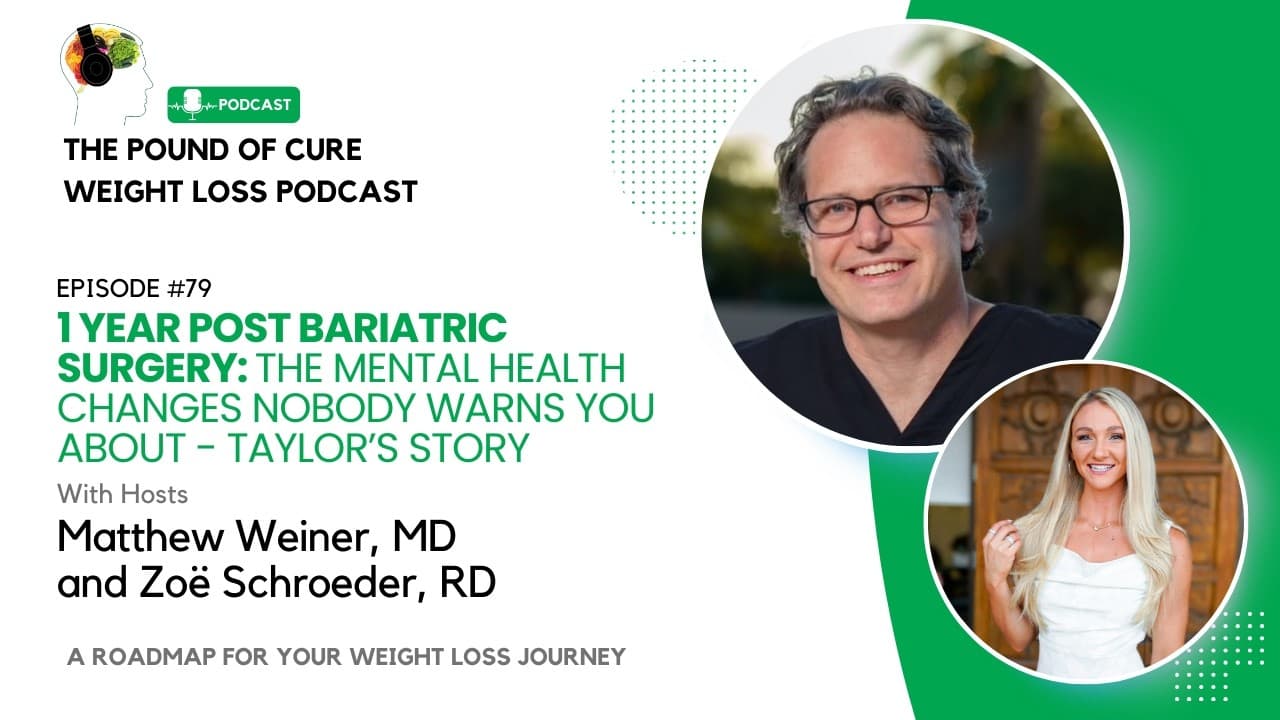
Episode 79: 1 Year Post Bariatric Surgery: The Mental Health Changes Nobody Warns You About - Taylor's Story
Introduction to Taylor's Journey
In this powerful patient interview, Taylor Hultquist shares her complete bariatric surgery experience one year after her gastric bypass procedure. Taylor opens the conversation with a remarkable story about how she became a patient of Dr. Matthew Weiner through an unexpected series of connections in Tucson, Arizona.
Taylor's primary care physician recommended Dr. Weiner for bariatric surgery, and she immediately recognized his name. Her family owns a Mexican restaurant that had catered Dr. Weiner's daughter's graduation party. Taylor actually delivered the catering and met Dr. Weiner at his home. Before leaving that day, she told him she had an upcoming appointment. Dr. Weiner emphasized the importance of completing the pre-surgery packet, advice that Taylor remembers vividly.
Talk with our team
Have questions about this episode?
Send our Tucson weight loss team a note about bariatric surgery, GLP-1 medications, nutrition, or your next step with Pound of Cure.
More from this episode
The Medical Motivation Behind Surgery
Taylor's decision to pursue bariatric surgery stemmed from a serious health concern. Her nephrologist warned that if she continued gaining weight without intervention, she would likely end up on dialysis. Having witnessed what dialysis did to her uncle, Taylor knew this was not a path she wanted to follow. She candidly shares that at her lowest point, she felt she would rather die than face dialysis.
This medical necessity, combined with her existing diagnoses of bipolar disorder, borderline personality disorder, anxiety, and depression, made her pre-surgery mental state extremely challenging. Taylor describes feeling so depressed before surgery that she questioned her purpose and why she was even here.
Dramatic Physical Transformation
Taylor's weight loss results have been extraordinary. Starting at a highest weight of 265 pounds and standing 5 feet 7 inches tall, she has lost over 130 pounds. At her one-year post-op mark, Taylor weighed 134.6 pounds, which Dr. Weiner notes is remarkably close to the historical ideal body weight calculation of 135 pounds for her height.
This calculation, dating back to the 1950s insurance life tables, was 100 pounds plus 5 pounds for every inch over 5 feet. While Dr. Weiner clarifies this is a historical number of note only and not something used clinically today, Taylor has achieved what she always considered her aspirational goal weight of 135 pounds.
Many people no longer recognize Taylor. She shares that parents of children she taught at a Catholic preschool before surgery walked right past her without recognition until she spoke. Her physical appearance has changed so dramatically that only her voice gives away her identity to people who knew her at her heaviest.
Life-Changing Non-Scale Victories
Beyond the impressive weight loss numbers, Taylor describes numerous quality-of-life improvements that mean even more to her than the scale.
Physical Activity Improvements
Taylor went hiking at Sabino Canyon with friends and discovered she could not only complete the hike but felt she could keep going when her companions were tired. She experienced no knee pain during or after the activity, something that would have been impossible before surgery.
At the gym, Taylor decided to try jogging on the treadmill. She planned to jog for one minute to test her capability. After that minute felt good, she continued and reached three and a half minutes of continuous jogging. This was a completely new experience for her, and the accomplishment brought genuine joy and pride.
Medical Health Improvements
Taylor's nephrologist appointment several months post-surgery brought remarkable news. He told her that her lab work had never looked better. Even more significantly, the cysts in her kidneys were shrinking, and her kidney itself had decreased in size. While the doctor could not definitively attribute these improvements solely to weight loss, he strongly suspected the connection. Taylor joked with him about participating in any future studies examining the relationship between bariatric surgery and polycystic kidney disease.
Clothing Size Changes
Shopping at American Eagle, Taylor tried on jeans and discovered that a size 8 was too big. A size 6 fit but not in the way she wanted. She ended up fitting comfortably into a size 4, nearly bringing her to tears in the dressing room. Her father witnessed her emotional reaction to this milestone. For someone who spent her entire life being larger than others and subject to hurtful comparisons, this represented a profound shift in her relationship with her body.
The Mental Health Transformation
Perhaps the most significant changes Taylor experienced were psychological rather than physical. She describes her mental health improvements as the most important outcome of her surgery journey.
Improved Confidence and Self-Perception
Taylor now responds to compliments about her appearance with confident agreement. When her mother tells her she is beautiful, Taylor replies that she knows she is. This represents a complete shift from her pre-surgery mindset when looking in the mirror caused distress and self-criticism. She now sees herself as beautiful both inside and out.
Reduction in Mental Health Symptoms
Around four months post-surgery, Taylor noticed that her depression, manic episodes, and other mental health symptoms were diminishing significantly. In consultation with her psychiatrist, she made the decision to discontinue her psychiatric medications to see if she could manage without them.
Taylor has successfully maintained her mental wellness without medication. She credits this to being happy with herself, recognizing her accomplishments, and developing better coping strategies. When things do not go as planned, she now asks herself how she can make the situation better rather than spiraling into negative thought patterns.
Dr. Weiner emphasizes an important message for listeners: if you are feeling hopeless and depressed, this is not necessarily a permanent state. While Taylor's transformation involved bariatric surgery and significant weight loss, there are other paths to improved mental health. The key takeaway is that feeling like all hope is gone does not mean you will always feel that way, even though it feels permanent in the moment.
The Difficult Early Recovery Period
Taylor's post-operative journey was not smooth or easy. She experienced significant complications that made her first four months extremely challenging.
Gastrojejunal Anastomotic Stricture
Taylor developed a stricture at the connection between her stomach pouch and small intestine. Dr. Weiner explains that this complication occurs in approximately 3 percent of gastric bypass patients, or roughly 1 in 30 to 35 cases.
During surgery, Dr. Weiner creates the connection over a tube called a bougie, specifically a 34 French bougie. This ensures the connection is consistently sized at just over one centimeter in diameter. However, in some patients, the body forms excessive scar tissue at this connection site three to four weeks after surgery, narrowing the opening to a pinhole.
Patients with strictures often feel like they are progressing well with soft foods like yogurt, cottage cheese, and applesauce, then suddenly have to backtrack in their diet progression. Food feels stuck, and eating becomes difficult or impossible.
The Stricture Treatment
Dr. Weiner treated Taylor's stricture with an outpatient endoscopy procedure. He used a scope to visualize the narrowed area and a balloon to dilate the scar tissue band. The procedure takes about five minutes, carries very little risk, and patients typically go home the same day with improved ability to eat that evening.
However, strictures can result in a much rougher post-operative course overall. They can cause ulceration and inflammation that decreases appetite and makes eating uncomfortable. Instead of feeling better at one to two months post-surgery, patients with strictures may not feel well until three months or longer. Taylor did not start feeling consistently good until around month four.
Dr. Weiner notes that once a stricture is treated and healed, it is behind the patient permanently. This is strictly a post-operative issue related to the intense scarring process immediately after surgery. It cannot recur a year or two later.
Interestingly, Dr. Weiner shares that strictures are associated with increased weight loss. Patients who experience strictures tend to lose more weight than those who do not. Taylor's projected maximum weight loss was around 80 pounds, but she has exceeded 130 pounds lost, which may be partially explained by her stricture.
The Emotional Impact of Complications
During her difficult early months, Taylor questioned her decision to have surgery. People would compliment her appearance and tell her she looked great, but she did not feel happy. She openly told people she regretted her choice and asked herself why she had done this.
Taylor remembers her appointment with Dr. Weiner the day after surgery at TMC hospital. She told him he had lied to her because she felt terrible. He asked if she felt better than the day before, and when she confirmed she did, he pointed out that he had not completely lied. This exchange shows the challenging reality of early post-operative recovery.
At one point, the option of reversal was discussed with Deidre, one of the bariatric team members. Taylor qualified for reversal but firmly declined. She had not gone through everything just to go backward. She was determined to push through the difficult period.
Learning to Eat After Surgery
Taylor has become highly skilled at recognizing her body's signals and practicing mindful eating. Dr. Weiner describes her approach as a master class in mindful eating, noting that after 20 years of practice, he has rarely heard a patient explain these concepts so clearly.
Body Signals and Eating Cues
Taylor's primary signal that she needs to pause or stop eating is a sensation of food feeling stuck. If she can burp, she knows she is okay to continue. If she cannot burp, she needs to stop eating, take a deep breath, and walk around. If the stuck sensation persists, it means she has eaten too much and will need to vomit.
Her friends have noticed she burps frequently and asked if this is related to surgery. Taylor confirms this is her body's way of communicating whether she is okay, needs to slow down, or has had enough food. She also experiences a feeling of fullness in her stomach as a secondary signal.
It took Taylor until about month six post-surgery to really tune into these signals. The first four months were too difficult with her stricture complications to establish these patterns. Now at one year and almost two months post-surgery, she uses these signals constantly, even when drinking water too quickly.
Mindful Eating Strategies
Taylor has developed several practical strategies for successful eating:
She reminds herself to put her fork or spoon down between bites, a technique discussed with Zoe from the bariatric team. This slows her eating pace and gives her body time to send fullness signals.
She recognizes that the same food can affect her differently on different days. Deidre, another team member, confirmed that you never truly know how your body will respond to a food on any given day. Taylor now approaches foods she has eaten before with caution, eating slowly to assess her body's response each time.
Before eating, Taylor considers which foods have been challenging for her in the past. If she plans to eat something difficult, like steak, she pairs it with something easier to digest, like broccoli. This strategy helps her complete her meal without getting sick.
Specific Food Tolerances
Certain types of meat, particularly steak, require extra caution for Taylor. She eats these very slowly and carefully.
For a long time, Taylor ate potatoes, eggs, and turkey bacon for breakfast despite Deidre's repeated suggestions to substitute fruit for potatoes. She kept getting sick but resisted the change. Finally, at her one-year post-op appointment, Taylor told Deidre she had taken her advice and switched to fruit. Deidre congratulated her, noting it only took a full year. Taylor immediately felt better with this modification.
Fried foods are almost completely eliminated from Taylor's diet. She can occasionally have a few crinkle fries, but this is very hit or miss. When she does eat something fried, she must eat very clean foods afterward. She recognizes this restriction is actually beneficial because fried foods contributed significantly to her pre-surgery weight gain.
Taylor has learned to ask herself whether the immediate gratification and dopamine hit from eating a desired food is worth feeling sick afterward. She has concluded that being disappointed for a minute by not eating something is far better than being disappointed and physically ill for hours afterward.
Zoe emphasizes the value of documenting these small victories and realizations. She recommends keeping a list of non-scale victories in your phone notes. On harder days when you question why you are doing this, you can review the list and see tangible proof of your progress. This data about lifestyle improvements can be even more powerful than scale numbers.
Setting Boundaries Around Weight Discussion
Taylor has become intentional about setting boundaries with family and friends regarding discussions about her weight and appearance.
At Thanksgiving with her mother, who had not seen her eat a meal this far post-surgery, Taylor established clear ground rules. She told her mother they would not make the entire gathering about her weight. People could tell her she looked great, but that was the boundary. Her mother asked questions about why Taylor ate in a certain way, taking frequent breaks. Taylor reminded herself that her mother did not understand her new eating patterns and tried to be informative rather than defensive.
Taylor has become protective of others dealing with weight issues. When people make comments that someone is ugly because they are fat or should not wear certain clothing because of their size, Taylor firmly corrects them. She tells people that if someone is happy in their clothing and with their body, that is all that matters. The number on the scale and other people's opinions are irrelevant. If someone is unhappy with their situation, they should take action for themselves, not because of external judgment.
Taylor's mother asked if she hides her surgery from people. Taylor explained she tells everyone openly. When her realtor asked to meet for dinner, Taylor assumed it was about their house sale. Instead, the realtor wanted to ask about bariatric surgery for his wife. Taylor sent them to Dr. Weiner's practice. The realtor asked about scarring, and Taylor offered to show him her stomach right there, which surprised her companions with her openness.
Taylor believes that if she has experienced something that might help someone else, she will be completely open and honest about it. She always begins by emphasizing that her experience is unique and may not match someone else's journey.
Advice for Others Considering Surgery
When people approach Taylor asking if they should have bariatric surgery, she has a consistent response. She tells them the decision must be 100 percent their own choice. It cannot be because their mother wants them to do it, because Taylor told them to, or because of what happened to Taylor. This must be what they want for themselves.
Taylor shares that she wishes she had known someone personally who went through bariatric surgery before her procedure. While she felt well-informed going into surgery, having a personal connection with someone who had lived the experience would have been valuable. This is why she now offers to speak with other patients who are struggling, particularly with mental health challenges.
She tells people considering surgery that there will be hard days, but hard days do not mean things will not get better. Progress happens one day at a time. She reminds them that everyone's journey is different. Some people have bypass surgery and are doing amazing at two months, eating what they want. Taylor's experience was different, with four difficult months before improvement, but that does not make her outcome bad or wrong.
Taylor documented her weight at every doctor's appointment and medical encounter for 12 months. She kept detailed notes tracking her progress over time, which helped her see patterns and improvements.
Dealing with Excess Skin
Having lost over 130 pounds and literally becoming half the person she was, Taylor addresses the reality of excess skin after massive weight loss.
Areas of Skin Changes
Taylor's arms have noticeable loose skin. Her legs, which were previously very thick in the thighs, are now half the size with some loose skin present. Her stomach has stretch marks that make it look like she has had children, according to her mother, though Taylor has not.
The area causing Taylor the most difficulty is her chest. Before surgery, she had large breasts, but now describes them as primarily skin rather than breast tissue. Fitting into a normal bra is difficult. Sports bras are most comfortable because regular bras do not provide adequate security. She often feels uncomfortable, like she might fall out of regular bras.
Plans for Body Contouring
Taylor plans to consult with a surgeon about breast surgery around 18 months post-op, giving herself a full year and a half of healing and stabilization. Her motivation is not cosmetic but functional. She wants to feel secure and comfortable, especially when working out.
Regarding her stomach, Taylor has a different perspective. While she sometimes wonders what her stomach would look like without stretch marks and loose skin, she views these changes as evidence of what she has accomplished and how far she has come. In her mind, surgically changing this would mean changing a part of herself that she worked extremely hard for.
Taylor has shifted away from her previous mindset of fixing everything surgically. She notes this change surprises her mother, as Taylor used to advocate for surgical solutions to any problem. This particular surgery journey has fundamentally changed her perspective.
Before pursuing any body contouring procedures, Taylor plans to commit to weight training and muscle building for at least eight months. She wants to see what she can accomplish naturally before considering surgical intervention. She recognizes that her weight loss resulted in muscle loss as well, so she is now focusing on weightlifting to build muscle, which may help with skin appearance.
Several of Taylor's doctors have commented that she has less excess skin than expected for someone with her amount of weight loss. Taylor wisely notes that comparing patients is not helpful since everyone's journey and body response is different.
Current Fitness Routine
Taylor has recently started playing pickleball and finds it tremendously fun. She marvels at her ability to run after the ball and play actively, something that would have been impossible one or two years ago.
She is working to establish a consistent weightlifting routine. Zoe recommends lifting weights three to four days per week in addition to walking, with optional running as desired. The priority should be strength training with progressive overload.
Zoe suggests Taylor keep a workout journal to document her progress. Writing down exercises and weights used will allow her to see non-scale victories like increasing from 5-pound to 10-pound bicep curls. This documentation provides tangible evidence of muscle growth and strength improvements beyond what the scale shows.
Taylor also focuses on eating consistently throughout the day and ensuring adequate protein intake, especially important now that her goal is to maintain weight rather than continue losing.
The Reality of Post-Surgery Eating Experiences
Taylor's Thanksgiving experience illustrates the ongoing reality of eating after gastric bypass. Her mother noticed she stopped eating and asked if she would eat more. Taylor said she needed to go for a walk. Her mother asked with concern if she was okay. Taylor's father, who lives with her and understands her eating patterns, explained to her mother that Taylor needed to see how the food settled and that she might need to vomit if food was stuck and she had eaten too much despite not clearly listening to her body's signals.
These moments are part of Taylor's daily reality. She must constantly assess whether foods will stay down, take walking breaks during meals, and respond to her body's signals in real time. Family members who do not see her regularly find these behaviors surprising or concerning, while those who live with her understand this is her new normal.
Looking Forward
Dr. Weiner expresses excitement about what Taylor's next year will bring. He notes that she has been incredibly intentional throughout her journey and has developed wisdom worth sharing with others. The podcast hosts plan to have Taylor back in the future to continue sharing her experience.
Taylor expresses deep gratitude to both Dr. Weiner and Zoe, describing them as key people in her journey. She credits them with helping her reach her current physical and mental health state.
At one year and almost two months post-surgery, Taylor exemplifies successful long-term bariatric surgery outcomes. Beyond the impressive weight loss, she has gained confidence, improved mental health, reduced medication needs, better kidney function, enhanced physical capabilities, and a fundamentally changed relationship with food and her body. Her story demonstrates that while the surgery is a tool, the real transformation requires learning new skills, listening to your body, setting boundaries, and taking progress one day at a time.
Additional Patient Success Story
Zoe mentions another Pound of Cure patient success at the episode's conclusion. Ms. Linda Jones is in the top 10 percent of a competition to be on the cover of Miss Health and Fitness 2026. Zoe encourages listeners to vote for Linda using the link in the show notes and expresses pride in Linda's remarkable progress.
Taylor's story offers hope, practical guidance, and honest reality for anyone considering bariatric surgery or currently navigating their post-surgery journey. Her willingness to share both struggles and victories provides invaluable insight into the complete bariatric surgery experience.
Weight loss topics covered in this episode
This conversation is part of the Pound of Cure approach to evidence-based weight loss education, including bariatric surgery, GLP-1 medications, nutrition counseling, metabolic health, and long-term patient support.
For more context, explore our guides to GLP-1 medications, bariatric surgery in Tucson, and the Metabolic Reset Diet.