Podcast Summary
Episode 80 Overview
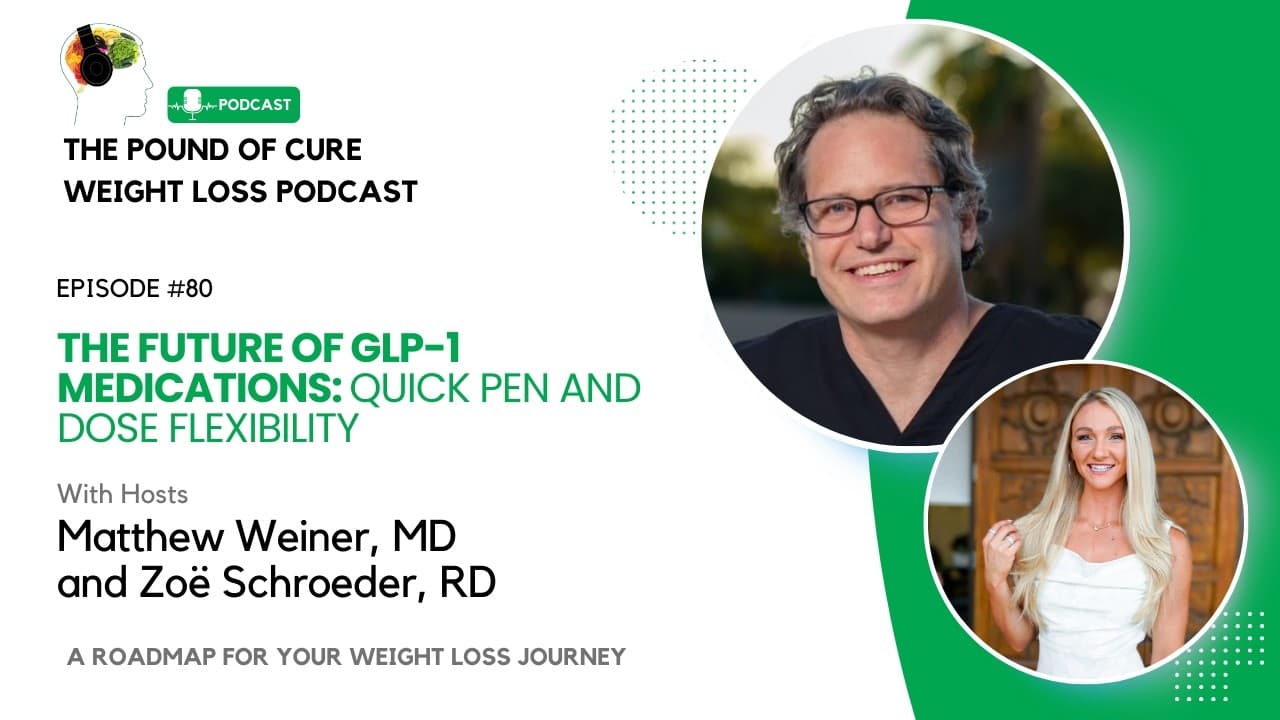
In this milestone 80th episode of the Pound of Cure Weight Loss Podcast, Dr. Matthew Weiner and Zoe discuss major advances in obesity medicine and their clinical practice. The conversation covers the beta launch of their new AI-powered app called Loli, the evolution of GLP-1 medication dosing with the Quick Pen technology, insights from recent research on GLP-1 prescribing practices, and answers to patient questions about post-bariatric surgery care and medication delivery options.
Introducing Loli: The New AI-Powered Weight Loss App
Background and Development
Talk with our team
Have questions about this episode?
Send our Tucson weight loss team a note about bariatric surgery, GLP-1 medications, nutrition, or your next step with Pound of Cure.
More from this episode
Dr. Weiner explains that the new app represents a complete rebuild from the ground up. The original Pound of Cure app has been transformed thanks to significant advances in artificial intelligence technology over the past few years. The capabilities that Dr. Weiner wanted to include in the first version are now possible with current AI technology.
Training the AI With Clinical Content
The Loli app has been trained using extensive clinical content from the Pound of Cure practice. This includes all 80 podcast episodes, nearly all of Dr. Weiner's educational videos, his books, and substantial nutrition content contributed by Zoe. The AI has been specifically trained to follow their treatment philosophy and approach.
How the App Works
The app mirrors the way Dr. Weiner sees patients in clinical practice. It walks users through a structured treatment algorithm by asking specific questions and learning about each individual. The core approach focuses on identifying your metabolic set point, figuring out what caused your set point to increase, and then creating a personalized therapeutic plan to help lower that set point.
As you enter information into the app over time, it learns and adapts. For example, if you report that a certain medication dose is causing nausea, the AI will provide guidance based on that feedback. The system becomes more personalized the more you use it.
Revolutionary Food Logging Features
One of the most exciting features is the AI-powered food logging system. Unlike traditional food tracking apps that require you to search databases, select foods, and measure serving sizes, Loli simplifies the entire process. You can simply take a picture of your food or describe it in words. The AI technology can actually measure plate size from photos and estimate portion sizes automatically.
Caloratio Scoring System Simplified
For current patients familiar with the Pound of Cure app, the Caloratio scoring system has been significantly enhanced. Instead of displaying a percentage that represents compliance with the metabolic reset diet, the new version uses letter grades. This makes it much easier to understand where you stand at a glance.
Zoe highlights a particularly useful feature: you can ask the app "How can I improve this?" and it will provide specific recommendations and talk you through better choices to achieve closer to an A-plus score.
Human Support Plus AI Technology
Dr. Weiner emphasizes that the model has always been AI plus human providers, not AI replacing human care. The new app provides significantly more access to Zoe and other support leaders. You can book appointments directly through the app or use a walk-in clinic feature to connect with whoever is available at the time. Both individual and group options will be available, with a focus on individual support.
Providers will be able to see what you have been working on in the AI, including the plans you have created, which allows for more seamless and informed support.
Beta Testing Timeline and Access
Beta testing will begin within the next week or two with a small group of initial testers. Within a few weeks after that, the app will roll out to all current Pound of Cure members. The app is named Loli, which is Dr. Weiner's wife's childhood nickname. You can see early screenshots and sign up to be a beta tester at gololi.ai.
The Quick Pen Revolution: Dose Flexibility for GLP-1 Medications
The Problem With Traditional Dosing
Dr. Weiner explains that cost and side effects are the two biggest issues with GLP-1 medications. Traditional single-injector pens contain a fixed dose. When you push the button, it delivers the entire predetermined dose with no ability to modify it. If your doctor prescribes an increase from 2.5 milligrams to 5 milligrams, you must take the full 5 milligrams even if that causes significant side effects.
This rigid dosing approach has caused many patients to experience severe nausea for one to two months during dose transitions. Even worse, it often leads to patients discontinuing the medication entirely.
How the Quick Pen Works
The Quick Pen technology, which has been available in Canada for some time and is similar to the Ozempic pen design, offers a different approach. Instead of a fixed dose, you turn a dial that clicks as you rotate it. Each pen has a set number of clicks to reach a full dose.
For example, if a 15 milligram pen has 60 clicks to the end, turning it only 30 clicks would deliver 7.5 milligrams, which is half the dose. Using the pen this way makes it last twice as long, cutting the cost in half. With 60 clicks available, there are essentially 60 different possible doses you can choose.
Clinical Benefits of Dose Flexibility
Dr. Weiner's practice has used dilution techniques as an off-label approach to achieve similar flexibility. Instead of jumping from 2.5 milligrams to 5 milligrams, they move patients to 3 milligrams, then 3.5 milligrams. This gradual approach causes essentially no side effects, making the treatment far more comfortable.
The Quick Pen brings this capability to all patients in a simple, safe way without requiring dilution techniques. It represents a major shift in how GLP-1 medications can be prescribed and adjusted.
Lifestyle Flexibility and Long-Term Compliance
Dr. Weiner points out that dose flexibility also allows for lifestyle adjustments. If you want to go on vacation for a week and eat a little more without feeling nauseous, you can adjust your dose. This mirrors how naturally thin people manage their weight. They might eat more on vacation, then return to normal habits and lose any gained weight.
With GLP-1 medications and the Quick Pen, you have the power to make similar adjustments. This flexibility means patients are more likely to stay on these medications long-term because they actually like taking them. Given all the health benefits of GLP-1 medications, long-term use is ideal.
Industry Recognition of Patient-Driven Dosing
Dr. Weiner hopes that Eli Lilly's introduction of the Quick Pen for Zepbound represents an acknowledgment that large-step incremental dosing with no patient ability to adjust is not the future of GLP-1 medications. Better patient experience leads to better compliance, which benefits both patients and pharmaceutical companies.
Research Update: Are We Prescribing GLP-1s Wrong?
The Medscape Article
Zoe introduces an article from Medscape by Dr. Taylor Cantor titled "Are We Prescribing GLP-1s Wrong?" The article mirrors the Pound of Cure practice philosophy in important ways.
Key Findings on Dosing and Support
The article emphasizes that dose adjustments should be dictated by patient response and side effects rather than following rigid protocols from pharmaceutical companies. Just as importantly, it stresses that simply handing out a meal plan or nutrition handout does not constitute support.
In Dr. Cantor's 68-week trial, patients who received genuine support lost approximately 22 percent of total body weight. The article makes clear that this success was significantly enhanced by the support they received, not just the medication.
The Support Challenge
Zoe explains that bridging the gap between medication as a quick fix and providing accessible, realistic nutrition support has been a major focus for Pound of Cure over nearly five years. The practice has invested significant energy and effort into developing this support because they have seen its value firsthand.
However, it has required extensive trial and error and many iterations. The goal is not to create a perfect nutrition program but to meet patients where they are. Buy-in and people showing up for themselves matters more than perfection. The program must fit into each person's actual life, not a theoretical ideal.
The new Loli app represents the latest evolution of this effort to provide support that is both effective and accessible.
Study Limitations and Context
Dr. Weiner provides important context about the article. The author owns a telemedicine company that sold compounded semaglutide, and the results were not peer-reviewed in the traditional way. It would not be considered a high-quality scientific study compared to FDA approval trials like the Surmount trial for Zepbound.
However, the article is valuable because it represents real-world clinical practice rather than controlled academic research.
Academic Versus Private Practice Medicine
Dr. Weiner draws a distinction between academic medicine and private practice. In academic settings, patients might be seen by a medical student, then a resident, then an attending physician for just a few minutes. This model tends to practice medicine "out of a book" rather than at the bedside.
In private practice at Pound of Cure, aside from a nurse weighing the patient, visits are entirely with Dr. Weiner from start to finish. This different model of care allows for adjustments based on what actually works for patients over time, not just what research protocols dictate.
The Problem With Trial-Based Protocols
Research studies are not optimized for individual patients. They are optimized for FDA approval and funded by pharmaceutical companies. The trial design for medications like Zepbound and Ozempic was exactly right for getting FDA approval, but wrong for individual patient care.
For example, pharmaceutical trials use fixed dosing schedules. If researchers allowed patients to dose however they wanted, the study would not produce good results or gain FDA approval. Dr. Weiner is not criticizing the trial design itself, but rather the assumption that clinical practice should rigidly follow those trial protocols.
Insurance Company Interference
The most damaging application of rigid trial-based dosing has been by insurance companies. Dr. Weiner describes situations where he would submit a prescription for a second month at 2.5 milligrams because the patient was doing well, only to have it denied. The insurance company would mandate moving to 5 milligrams based on the trial protocol, even if that dose would cause severe side effects.
Thankfully, the practice developed dilution techniques to work around these restrictions. They taught patients how to squirt the medication into a vial, dilute it, and draw out the appropriate dose. These workarounds have been necessary because the system does not always serve patients well.
Moving Toward Patient-Driven Care
Dr. Weiner sees the Medscape article and the Quick Pen as signs that the field is moving toward patient-driven dose advancement strategies. These approaches result in less discomfort and fewer side effects. While this particular study is not definitive proof that should change all clinical practice, it represents progress in the right direction.
For Dr. Weiner, this is not news because he has been practicing this way for years based on direct patient care. However, it is encouraging to see more evidence appearing in the literature supporting this approach.
Patient Questions: Post-Bariatric Surgery Care
Question About Gastric Bypass Complications
A YouTube commenter named Christina Gonzalez asked about her options after gastric bypass surgery. She reports having a hernia and experiencing severe pain and dry heaving.
First Step: See a Bariatric Surgeon
Dr. Weiner's first recommendation is straightforward: see a bariatric surgeon for evaluation. This is essential for proper diagnosis and treatment.
Five Critical Rules After Gastric Bypass
Dr. Weiner outlines five rules that all gastric bypass patients must follow:
-
No tobacco use whatsoever. Smoking is absolutely prohibited after gastric bypass surgery.
-
No NSAID medications. This includes no Advil, ibuprofen, aspirin, or similar drugs. Tylenol only for pain management.
-
Little to no alcohol. Ideally none at all. This topic has been covered extensively on previous podcast episodes.
-
Take a bariatric vitamin with iron. Get your iron levels and other labs checked regularly.
-
Do not eat garbage food. If you eat fast food and experience vomiting, gagging, or heaving, the problem is the fast food, not the gastric bypass.
If you are violating any of these rules, your symptoms may be a direct consequence. The first step is to address these issues.
Types of Hernias and Their Significance
Dr. Weiner explains that there are different types of hernias: umbilical, incisional, ventral, inguinal, and hiatal. Hiatal hernias occur when the stomach slides through the diaphragm up into the chest.
A small hiatal hernia after gastric bypass is typically not significant and rarely causes substantial side effects. If someone reports vomiting and has a small hiatal hernia, Dr. Weiner would look for other causes rather than assuming the hernia is the problem.
Diagnostic Testing: Endoscopy
The next important test is an endoscopy to check for ulcers or chronic strictures. If the bypass surgery was performed four to six weeks ago, an acute stricture is possible. This occurs when a band of scar tissue forms across the surgical connection.
Acute strictures are actually a simple fix. During an endoscopy, the doctor can stretch and break open the scar band. Patients can typically eat normally that same evening after the procedure.
Dietary Adjustments for Food Intolerance
Zoe provides detailed nutrition guidance for patients experiencing food intolerances after gastric bypass.
Assessment First: The starting point is understanding what the person is actually eating so you can identify specific problems for that individual.
Small Frequent Meals: Eating smaller portions more frequently helps you be more attuned to your body's signals and avoid overwhelming your digestive system.
Mindful Eating: Many people eat mindlessly while driving, watching TV, or looking at screens. When your attention is elsewhere, you cannot pick up on your body's cues about fullness or discomfort. Being present during meals, as discussed in a previous episode with patient Taylor, is crucial for learning your body's new signals after surgery.
Whole Real Unprocessed Foods: The golden standard is having more than 80 percent of your diet come from whole, real, unprocessed foods. This foundation will keep you in good shape.
Protein Quality Matters: While getting adequate protein is important, how you get that protein makes a difference. Are you relying on fatty cuts of meat, processed foods, protein bars, and protein shakes that your body may not tolerate well? Instead, prioritize whole food plant-based protein sources and lean animal protein sources. This approach helps you meet protein needs while also getting other essential nutrients.
Fiber and Produce: Many bariatric surgery patients have been trained to be extremely protein-focused. During the initial honeymoon period when weight loss is rapid, this focus makes sense to preserve muscle tissue. However, in maintenance mode, while baseline protein remains important, filling your plate with produce and fiber-rich plants becomes more critical.
This approach provides volume, essential fiber, and helps your body respond better. Most importantly, adequate fiber and produce intake keeps your metabolic set point at its new low level.
This Is a Solvable Problem
Dr. Weiner emphasizes that 90 percent of the time, these issues can be resolved. With evaluation by an experienced bariatric surgeon and work with a bariatric dietitian who can review food logs and provide specific suggestions, most patients can get back to normal.
There is an identifiable cause for these symptoms. While the original question seemed to contain frustration and fear, Dr. Weiner reassures patients that this is not a difficult problem. It is something that can be figured out and fixed.
Patient Questions: GLP-1 Pills for Maintenance
Background on the GLP-1 Pill
In a previous episode, the podcast discussed the introduction of oral GLP-1 medications. Many YouTube commenters have asked whether the pill form can be used for maintenance after weight loss, whether that weight loss came from bariatric surgery, GLP-1 injections, or a combination.
The Answer: It Depends on the Individual
Dr. Weiner explains that whether GLP-1 pills work for maintenance remains to be seen and will vary by individual.
GLP-1 Medications Are Personal
An important observation from clinical practice is that people develop an intensely personal relationship with GLP-1 medications, much more so than with other drugs. With medications like blood pressure pills or even other diabetes medications that do not affect appetite and weight, switching to a different drug is a simple transaction based on health benefits, cost, and side effects.
With GLP-1 medications, the experience is fundamentally different because they impact how you feel on a minute-by-minute basis. There are noticeable differences between semaglutide and tirzepatide (Zepbound), and there will be differences between injectable and pill forms.
Efficacy and Tolerability Will Determine Use
Dr. Weiner believes that how these medications make people feel and how well they work will ultimately dictate what formulation patients choose, what maintenance looks like, whether injections or pills are preferred, and all other decisions.
Some people will be able to use pills successfully. Others will find that pills cause more side effects and will prefer injections because they work better and cause less discomfort. The determining factors will be efficacy and tolerability, not route of administration or formulation.
Ongoing Clinical Experience
This is something the practice is actively working through with patients. Dr. Weiner currently has about a dozen patients experimenting with different approaches to figure out what works best. The answer will be different for each person.
Importance of Independent Medical Advice
Dr. Weiner stresses the importance of working with a provider who is comfortable and familiar with GLP-1 medications and who is not biased by financial conflicts of interest.
Some telemedicine companies are essentially drug sales companies rather than healthcare companies. He compares this to choosing a financial advisor. He specifically selected a financial advisor who does not sell insurance or other products and only makes money from the fee paid for advice. This ensures the advice is truly in his best interest.
When talking to your doctor about GLP-1 medications, consider whether the person works for a company that profits from drug sales. If so, you are likely to get drugs because that is what generates revenue. If you want to switch to a pill or try something new that the company does not sell, they may not offer that option because there is no profit mechanism.
If you simply want access to medication and that model works for you, that is fine. Just understand that you may not receive truly independent advice about all your options.
Prediction: Not Everyone Will Switch to Pills
Dr. Weiner does not believe everyone will switch to oral GLP-1 medications. The idea that pills will universally replace injections does not match what he sees in clinical practice.
Community Engagement and Social Media Update
Positive Feedback From the Community
Zoe shares a comment from YouTube user Nikki Smith who said she cannot wait to share the podcast link with a friend on Reddit who is struggling with sadness and mourning her old self after weight loss. Nikki called it an excellent post.
This comment references a previous episode discussion about the emotional challenges of weight loss and body image changes. Zoe appreciates that listeners are already starting to share content on Reddit, a platform the podcast has discussed entering.
Current Social Media Presence
Due to being hacked, Pound of Cure is no longer active on Instagram or Facebook. However, the podcast is still active on TikTok and YouTube. Dr. Weiner expresses that he is okay with stepping away from Meta platforms, noting concerns about their impact on children's mental health.
YouTube is now the primary place to submit questions and engage with the podcast community. Listeners are encouraged to leave questions in the comments on YouTube videos.
Final Thoughts and Looking Ahead
Zoe encourages listeners to share in the comments what they are working on, what has worked for their weight loss, and any particular struggles the podcast can help address. Building community engagement is a priority.
Dr. Weiner reminds listeners that if they are interested in being a beta tester for the new Loli app, they can fill out a form at gololi.ai.
The podcast will feature more patient interviews in upcoming episodes. Both hosts express appreciation for their listeners and the growing community around the Pound of Cure Weight Loss Podcast.
Weight loss topics covered in this episode
This conversation is part of the Pound of Cure approach to evidence-based weight loss education, including bariatric surgery, GLP-1 medications, nutrition counseling, metabolic health, and long-term patient support.
For more context, explore our guides to GLP-1 medications, bariatric surgery in Tucson, and the Metabolic Reset Diet.