
Podcast Summary
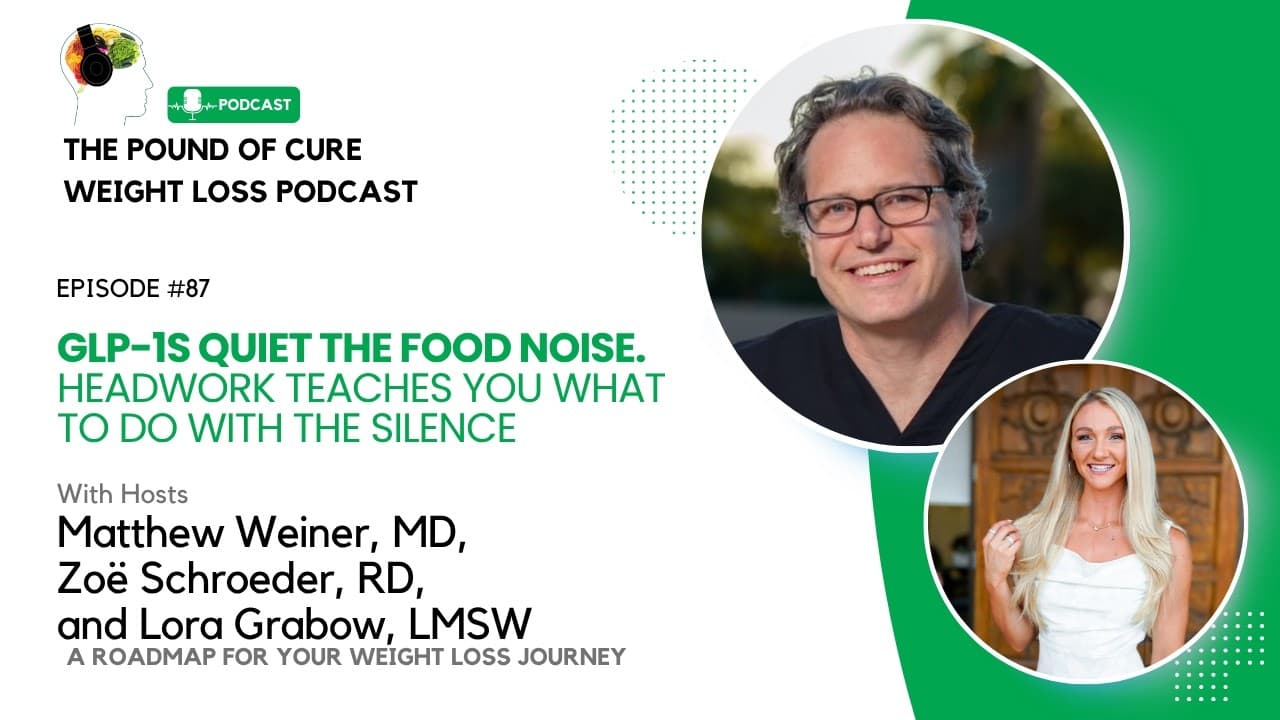
Episode 87: GLP-1s Quiet the Food Noise. Headwork Teaches You What to Do With the Silence with Lora Grabow, LMSW
Weight loss therapist Lora Grabow, LMSW joins Dr. Matthew Weiner and Zoe on the Pound of Cure weight loss podcast to discuss the critical but often missing piece of weight loss treatment: headwork. With 23 years of experience supporting medical and surgical weight loss patients, Lora explains why managing your biology with tools like GLP-1 medications or bariatric surgery is only the first step. The real transformation happens when you learn what to do with the mental space these treatments create.
What is Headwork and Why Does It Matter?
Lora distinguishes headwork from mindset work in a powerful way. Mindset focuses on what you think. Headwork teaches you what to do with what you think. That difference defines the entire conversation.
Talk with our team
Have questions about this episode?
Send our Tucson weight loss team a note about bariatric surgery, GLP-1 medications, nutrition, or your next step with Pound of Cure.
More from this episode
As Lora explains, headwork examines your relationship with food at a deeper level. It explores what your thoughts have to do with eating, what your emotions communicate, the stories you tell yourself, and the childhood messages you carry. Information only becomes transformation when you know how to act on it.
Dr. Weiner notes that traditional psychology often focused 100% on diagnosis with little attention to treatment. You could spend years exploring why you thought a certain way without learning how to change those patterns. Headwork provides the actionable treatment component that moves beyond understanding into practical behavior change.
The Power of the Pause: Three Steps to Managing Food Noise
Lora shares her three-step framework called the power of the pause. When you feel the urge to eat, especially in response to emotions rather than physical hunger, these three questions can transform your response:
Step 1: What Are You Thinking?
Every time we eat, a thought comes first. Most people don't realize this because nobody has taught them to notice it. Lora helps patients catch their automatic thoughts.
For example, if you're eating late at night because you're anxious about work tomorrow, the thought might be "I'm stressed, I deserve to eat" or "I need to take the edge off with food." Lora teaches patients to catch, check, and change that thought by asking: Is eating the best choice for me right now?
Step 2: What Are You Feeling?
The second step involves naming your emotion. Instead of saying "I'm stressed," Lora teaches patients to dig deeper and say "I'm feeling overwhelmed" or "I'm feeling anxious." This distinction matters because you are not your feelings.
Lora believes feelings are messengers. When you notice you're feeling anxious and overwhelmed, the message isn't "you're hungry, feed yourself." The real message might be "I need to decompress" or "I need to soothe myself." These are healthy needs. The question becomes: What are healthier ways to meet those needs besides eating?
Step 3: How Will You Respond?
Patients typically respond to off-plan eating with shame. Lora's passion involves lifting that shame and helping patients respond with self-compassion instead.
Rather than asking "Why did you do that? You know better," Lora teaches patients to say "I have a hard day at work tomorrow. It's okay that I'm feeling anxious. What do I need right now? What would I tell a good friend she needs?"
This self-compassionate approach creates space for healthier choices without the destructive spiral of shame.
Obesity as Disease, Not Decision
A fundamental principle underlying all of Lora's work is the understanding that obesity is a disease, not a decision. This message often reaches patients for the first time in weight loss clinics.
Dr. Weiner describes how patients routinely say "it's all my own fault" or "I did this to myself." Yet when you examine their stories, every moment of weight gain becomes completely understandable and often outside their control. Menopause, pregnancy, weight-gaining medications, loss of loved ones, all contribute to weight gain. These difficult life circumstances deserve compassion, not blame.
Patients have been blamed for their weight by healthcare providers for years. Weight stigma and weight bias from the medical community itself creates enormous shame. Lora describes her role as "shame lifter." When patients realize they're not bad people but rather people with a disease who are entitled to treatment, the shame lifts. When shame lifts, behavior change becomes possible.
Understanding Shame Versus Guilt
Lora teaches Brené Brown's research on the critical difference between shame and guilt:
Shame says "I am a mistake." It's about character.
Guilt says "I made a mistake." It's about behavior and choices.
Brené Brown's research shows shame is highly correlated with self-destructive behaviors like binge eating, isolation, and avoiding support groups. Contrary to popular belief, you cannot shame people into healthy lifestyle changes. Shame actually produces the behaviors you don't want.
Guilt, on the other hand, correlates with healthy behavior change because it removes the character issue and focuses on specific actions you can modify.
When a patient has a day of unplanned eating, they typically use character language: "I screwed everything up, I'm a cheater, I was bad, I was naughty." Lora teaches them to reframe: "You had some off-plan eating. You can choose to go back on plan or stay off plan. It's up to you, but it has nothing to do with your character."
GLP-1 Medications and the Missing Headwork Component
Lora observes that while the medical community is slowly understanding obesity as a disease, society has a long way to go. Despite high-profile advocates like Oprah discussing the biological basis of weight, enormous stigma and judgment still surround GLP-1 medications like Zepbound, Wegovy, and Ozempic.
Many doctors still say "I don't prescribe that." Lora shares a personal story of a client whose endocrinologist refused to prescribe GLP-1 medication despite the patient struggling with weight regain after bariatric surgery and worsening diabetes. Lora, despite being a therapist rather than a medical provider, told the patient she needed a new doctor. The patient switched providers, started medication, and is doing extremely well.
Lora's key message about GLP-1s: These medications quiet the food noise, but headwork teaches you what to do with the silence. After 23 years in this field, Lora sees the same piece still missing from treatment plans. It was missing from bariatric surgery programs, and now it's missing from GLP-1 treatment plans.
Lora's Personal Journey with GLP-1 Medication
Lora shares her own experience starting Zepbound in June 2025. After an unexpected hysterectomy in October 2022 and entering perimenopause, she noticed significant body changes. Despite hormone replacement therapy, she experienced what many women call "the menopause middle."
Despite being a tall woman (six feet) who was getting adequate protein, tracking macros, doing cardio, and strength training, the scale kept climbing. At breakfast one Friday, a close friend gently asked if Lora had considered trying a GLP-1.
The question stopped Lora in her tracks. She teaches this material. She understands the biology. She had immersed herself in the biology of menopause. Yet she still harbored "stinking thinking" that she had to earn help. How many times had she heard that from patients?
That moment of community support, where someone who cared could see something Lora couldn't see in herself, prompted her to reach out to Dr. Weiner. She started Zepbound in early June and reports doing great.
What Lora Learned from Taking GLP-1s
Lora initially told Dr. Weiner she didn't have food noise as typically described. She wondered if Zepbound would work for her. Dr. Weiner explained she would notice her efforts actually working and moving the scale.
What Lora discovered was that she has more space in her brain now. What quieted wasn't constant thoughts about food. Instead, what quieted was how hard she was being on herself when she saw pictures of herself or when she ate something. Even though she teaches that food doesn't have morality, she was still making judgments.
On Zepbound, Lora feels more confident and more free. This personal experience reinforces her message: quieting food noise (or in her case, negative self-talk) doesn't solve everything. You still need to do the emotional headwork for lasting change.
Lora now shares her story to lift shame for others. If Laura Grabow chose to put a GLP-1 in her toolbox, other people can make that choice without shame. You don't have to earn treatment for things related to your biology. You don't earn treatment for other biological illnesses, and you don't need to earn it here.
The 70% in the Middle: Why Headwork Matters
Dr. Weiner explains a critical concept about GLP-1 response rates that hasn't reached public awareness:
15% of people taking GLP-1s are super responders. They will lose weight no matter what. They barely need to worry about headwork, nutrition, or exercise for weight loss purposes (though these remain important for overall health).
15% are non-responders. The medications simply won't work for them due to their individual biology, often causing side effects or failed weight loss.
70% fall in the middle. They're not super responders and not non-responders. This is where headwork, nutrition, and exercise become absolutely critical for success.
Our social media algorithms only show the super responders or the dramatic non-responder stories. We don't see the 70%, which is where most people will fall. For this majority, the combination of medication plus behavioral work makes all the difference.
Earning Results, Not Earning Help
Dr. Weiner reframes the concept of "earning" in weight loss. The idea of earning help is exactly wrong. Instead, you should earn the results.
We believe we can overcome our biology through willpower, but we can't. When someone takes a weight-gaining medication, they will eat more. The idea that they can simply choose not to eat more is theoretical and doesn't happen in practice.
Because our food environment is highly processed and food is constantly available, tiny behaviors that wouldn't normally cause weight gain will cause weight gain when you're fighting biological forces working against you.
Getting the biology under control first, whether through GLP-1 medications or bariatric surgery, gives you the opportunity to make behavioral changes and earn your results. The Pound of Cure metabolic reset diet is not easy to follow, but it becomes so much easier on 2.5 or 5 milligrams of Zepbound.
Headwork, nutritional changes, and exercise come after the biology is addressed, not before. It's exponentially easier with biological support.
Root Cause Analysis: Moving Beyond the Eating
Dr. Weiner connects headwork to root cause analysis. When Lora evaluates a thought like eating at night due to anxiety about work, she helps patients work toward the root cause. The eating is just a symptom.
Lora's daughters, now 20 and 23, used to ask when they were little: "How can you spend so much time just telling people not to eat their feelings?" Lora explains it's so much bigger than that.
Patients may never have been given skills to name and feel feelings. Many come with adverse childhood events. The effects of weight stigma and weight bias run deep. The work is multi-layered and nuanced.
Lora teaches emotional agility alongside physical agility. How can you show up to your feelings in non-food ways? How can you do life with an uncomfortable feeling? Society has lost the plot, as Lora's daughters say. We're trying to eliminate uncomfortable feelings rather than learning to cope with them.
Feelings as Messengers, Not Emergencies
Lora emphasizes that feelings are messengers, not emergencies. They can be comfortable or uncomfortable, and we can get through them in healthier ways.
She references psychologist Dr. Susan David's work on emotional agility. Dr. David teaches that we shouldn't label feelings as positive or negative, but rather as comfortable and uncomfortable or pleasant and unpleasant. Every emotion serves a purpose.
Dr. David shares a powerful concept: people who want to avoid all uncomfortable emotions have "dead people goals." The only people not feeling uncomfortable emotions right now are dead. Discomfort is the price of life.
Lora teaches patients that of course they don't want to feel discomfort. She would be worried if someone said they were excited to go through emotional pain. But feelings aren't emergencies. They're experiences we can move through.
Dopamine, Numbing, and Coping
Dr. Weiner discusses how our modern world offers constant opportunities for dopamine hits. As humans, we're wired to love that dopamine pump, so there's always a market for quick fixes.
Dopamine will get you past an uncomfortable feeling quickly, but it won't last. That TikTok video, that processed food snack, that cigarette, that drink, that vape provides temporary numbness. Many people have conditioned themselves to reach for these quick hits rather than doing deeper work.
Lora clarifies the distinction: food, cigarettes, doom scrolling are all about numbing through the discomfort. She teaches how to cope through the discomfort instead.
Coping tools include mindfulness skills, deep breathing, and naming feelings. Lora is passionate about group work, stating "community is treatment." Patients need connection with others facing similar challenges.
The Power of Group Support
Lora facilitates support groups on emotional eating. When patients share that they're lonely and identify that they're hungering for connection, the group itself becomes the treatment.
At the end of a recent group session, Lora asked participants how they felt. They responded: proud, not alone, seen, heard, good, happy. Then Lora asked the mic drop question: "Is that how you feel after you emotionally eat?"
The lightbulb moment hits. Emotional hunger persists despite eating because food doesn't address the actual need. When you feed emotional hunger the appropriate thing, like connection with others, you feel genuinely better without the guilt and shame that follows emotional eating.
Patients often say the coping techniques Lora teaches don't work like pizza or chocolate. Lora agrees: "You're right. They don't work like food because it's not about numbing. It's about coping through." She reminds patients: "Your feelings are worth more than French fries."
When you numb with food, you end up with two things to escape: the original feeling and now intense anger at yourself. The shame cycle begins: "What did I do that for? I can never do anything right. Here's the beginning of the end. I'm failing my surgery. I'm failing my GLP-1."
The Arrival Fallacy and Dead People Goals
Dr. Weiner connects this to the arrival fallacy, the mistaken belief that once you achieve something (a certain job, a goal weight, any desired outcome), you'll somehow be freed from life's struggles.
He uses Elon Musk as an example. The person with more financial resources than anyone on the planet still has a very complicated, often unpleasant-looking life. If the person with the most resources can't find lasting happiness and contentment, what does that tell us?
It leads to a crucial realization: it's okay to be unhappy. It's okay to be uncomfortable. That's simply part of being alive.
Lora observes that our culture has become obsessed with eliminating discomfort. We want a pill for everything. We don't want to hear that healing takes time. We want instant solutions. We don't want our children to feel uncomfortable.
But life includes suffering. The question isn't how to eliminate it. The question is: how do I get through it in the healthiest way? And the answer isn't French fries.
The Physical Therapy Analogy
Zoe offers a perfect analogy: taking GLP-1 medication and doing headwork is like doing physical therapy to heal a knee injury. PT is uncomfortable, but you're actually healing the injury.
The alternative is getting a steroid injection with lidocaine so you can play through the pain. Dr. Weiner notes this is exactly what happens with professional athletes. The injection numbs the pain temporarily, allowing them to continue damaging the injured knee, which leads to worse outcomes long-term.
Emotional eating works the same way. It's lidocaine for your feelings. It provides temporary numbness while making the underlying problem worse. As a society, we've gotten very good at minimizing discomfort. But growth comes from discomfort. Healing comes from discomfort.
This is deeply human. It's completely natural to want temporary numbness and avoid the harder, deeper work. Recognizing that tendency without judgment is the first step.
What to Do When the Food Noise Gets Quiet: Free Workshop
Lora is offering a brand new free workshop on September 16th at 7:00 PM Eastern time called "What to Do When the Food Noise Gets Quiet."
The workshop goes deeper into what headwork actually means. Lora has redesigned her framework for explaining headwork and will walk participants through practical exercises to do root cause work and identify patterns.
The workshop is completely free with no limit on attendees. If you can't attend live, a replay will be available. This is an opportunity to take the concepts from this podcast episode and turn them into actionable steps you can implement in your own life.
Registration information is available in the show notes, and you can find details on Lora's website and social media channels.
Key Takeaways for Your Weight Loss Journey
Whether you're considering bariatric surgery, taking GLP-1 medications, or working on weight loss through other methods, the headwork component remains essential:
Biology first, behavior second. Get your biological factors under control with appropriate medical treatment, then focus on behavioral changes. It's exponentially easier in that order.
Practice the power of the pause. When you feel the urge to eat emotionally, slow down and ask: What am I thinking? What am I feeling? How will I respond to myself?
Lift the shame. Obesity is a disease, not a decision. You don't need to earn treatment. Replace shame-based self-talk ("I am a mistake") with guilt-based awareness ("I made a mistake").
Recognize feelings as messengers. Your emotions communicate needs. Anxiety about work tomorrow means you need to decompress, not that you need food.
Cope, don't numb. Food, social media, and other quick dopamine hits provide temporary numbness but make problems worse. Coping strategies like mindfulness, naming feelings, and connecting with others address actual needs.
Seek community. Isolation feeds shame. Connection with others facing similar challenges becomes part of the treatment itself.
Accept discomfort as part of life. Dead people goals don't serve you. Living means experiencing uncomfortable emotions. You can learn to move through them.
Remember the 70%. Most people aren't super responders or non-responders to weight loss treatment. For the majority, combining medical treatment with headwork, nutrition, and exercise creates success.
Lora Grabow has spent 23 years helping patients discover that weight loss treatment without headwork leaves out a critical component. GLP-1s and bariatric surgery quiet the noise, whether that's food noise or negative self-talk. Headwork teaches you what to do with that newfound silence. Information becomes transformation only when you know how to act on it.
As Lora reminds us: your feelings are worth more than French fries. They're messengers deserving of your attention and compassion, not symptoms to numb away. Learning what to do with what you think, that's where lasting change happens.
Weight loss topics covered in this episode
This conversation is part of the Pound of Cure approach to evidence-based weight loss education, including bariatric surgery, GLP-1 medications, nutrition counseling, metabolic health, and long-term patient support.
For more context, explore our guides to GLP-1 medications, bariatric surgery in Tucson, and the Metabolic Reset Diet.