Podcast Summary
Medicare GLP-1 Bridge Program: Complete Guide to $50 Wegovy and Zepbound Access
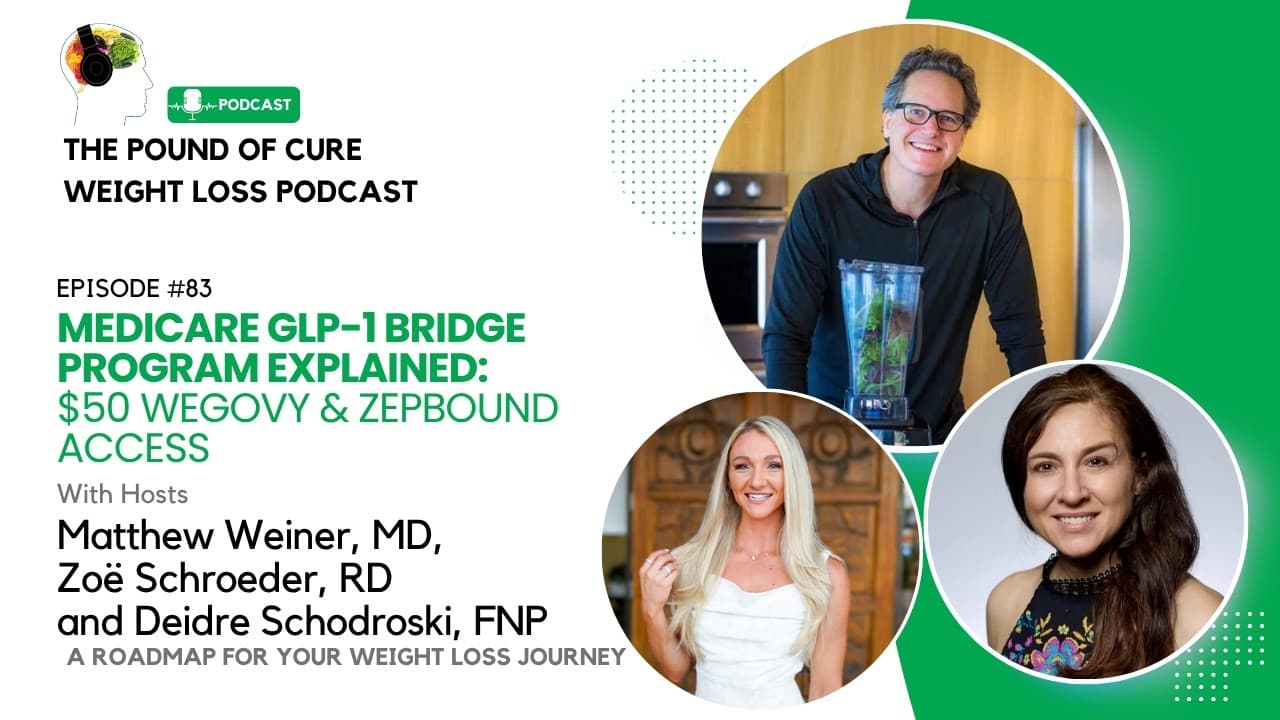
The Medicare GLP-1 Bridge Program launches July 1st, 2026, offering eligible Medicare patients access to Wegovy, Zepbound, and oral GLP-1 medications for a flat $50 per month copay. However, as Dr. Matthew Weiner, Deidre FNP, and Zoe explain in this Pound of Cure Weight Loss Podcast episode, the qualification process is significantly more complex than simply getting a prescription.
What Is the CMS Medicare GLP-1 Bridge Program?
The Center for Medicaid Services (CMS) Bridge Program is a limited-run initiative that will operate from July 1, 2026 through December 31, 2027. The program provides access to Zepbound quick pens, Wegovy injector pens, and oral GLP-1 medications directly from CMS for a $50 monthly copay.
Talk with our team
Have questions about this episode?
Send our Tucson weight loss team a note about bariatric surgery, GLP-1 medications, nutrition, or your next step with Pound of Cure.
More from this episode
Deidre emphasizes that this is not a permanent program. After the initial run ends in December 2027, the program will need to be expanded and approved for continuation. The hope is that the program will prove successful enough to warrant extension.
Medicare Part D Requirement: The First Major Qualification
The single most important eligibility requirement is Medicare Part D prescription coverage. Without Part D, you cannot participate in the bridge program, regardless of other qualifications.
Understanding Medicare Part D
Medicare Part D is a standalone prescription plan that can be added as a supplement to Medicare Part A and B. Medicare Part A and B alone do not include prescription coverage. Part A covers hospital costs, while Part B covers outpatient clinical costs.
Medicare Advantage vs. Medicare Supplement Plans
If you have a Medicare Advantage plan (such as AARP or similar all-in-one Medicare plans), Part D prescription coverage comes automatically included. You do not need to sign up separately.
If you have a Medigap or Medicare supplement plan, you must choose your prescription plan separately. Most people choose Part D because not having Part D can result in penalties on your Medicare Part A and B coverage when you eventually do sign up for a prescription plan.
State and Federal Retirement Plans May Not Qualify
Deidre notes that some state-supported plans and federal retirement plans are not considered Medicare Advantage plans and may not include Part D coverage. She encountered a patient with Medicare Part A and B plus a federal retirement plan that did not have Part D, making that patient ineligible for the bridge program.
How to Check Your Part D Status
You can visit Medicare.gov and enter your Social Security number or plan information to access your plan documents. However, Deidre warns that the information is not presented clearly. She had to open and read through the full plan documents to confirm Part D coverage, as the website did not simply state whether Part D was included.
Pound of Cure Weight Loss has created a tool on their website (poundofcureweightloss.com) that allows you to check your comorbid conditions and verify eligibility. The practice continues to develop and improve this tool as they learn more about the program requirements.
Adding Part D Coverage
If you do not currently have Part D coverage, you can purchase it as a standalone plan. However, enrollment is restricted to specific open enrollment periods. The main open enrollment period runs from approximately late October through November and December. There is also a smaller open enrollment period in February or March for people changing plans based on specific circumstances.
BMI and Comorbidity Requirements: Who Qualifies Medically?
The medical qualification criteria for the bridge program are strict and tiered based on BMI levels.
BMI 35 or Above
Patients with a BMI of 35 or above qualify with no additional comorbidities required.
BMI 32 to 35
For patients with a BMI between 32 and 35, qualifying comorbidities include:
- Previous heart attack or stroke
- Peripheral arterial disease with prior procedure or abnormal ankle brachial index (ABI)
- Uncontrolled hypertension (blood pressure over 140/90 while taking two blood pressure medications)
Peripheral arterial disease refers to arterial (not venous) conditions. Examples include patients who have had femoral popliteal bypass surgery due to leg artery obstruction, coronary artery stents, or aortic stents. The ankle brachial index is used to measure peripheral arterial disease.
The uncontrolled hypertension requirement is specific: you must already be taking two medications and still have a blood pressure reading over 140/90.
BMI 27 or Above
This category significantly expands access. Patients with a BMI of 27 or above qualify with:
- Previous heart attack or stroke
- Peripheral arterial disease with prior procedure or abnormal ankle brachial index
- Uncontrolled hypertension (same criteria as above)
- Prediabetes (A1C of 5.6 or above)
The addition of prediabetes as a qualifying condition opens up coverage considerably, as prediabetes is fairly common. All that is needed is a recent lab result showing an A1C of 5.6 or above.
Initial BMI vs. Current BMI
According to the CMS website, the program will use your initial BMI from when you started GLP-1 medications if you are already taking a GLP-1. This is particularly important for self-pay patients and those using diluted medications who may have already lost significant weight.
The Critical Exclusion: If You Qualify Through Other Diagnoses, You Cannot Use the Bridge Program
This is one of the most confusing and frustrating aspects of the program. If you can get your GLP-1 medication covered through your regular Medicare Part D benefit using certain other comorbidities, you are not eligible for the bridge program, even if the bridge program would be less expensive.
Disqualifying Diagnoses
You cannot use the bridge program if you qualify for GLP-1 coverage through your regular Part D plan with:
- Diabetes (A1C of 6.5 or above)
- Moderate to severe obstructive sleep apnea
- Moderate to severe liver fibrosis resulting from non-alcoholic fatty liver disease
Many patients are already receiving GLP-1 medications through their Medicare coverage using these comorbidities. Even though the bridge program may offer a lower copay, these patients are excluded from participating.
Deidre notes that patients with Medigap or Medicare supplement plans who qualify through these diagnoses may still face copays of $500 or more per month, yet they cannot take advantage of the $50 bridge program pricing.
The Two-Step Prior Authorization Process: Why This Is So Complicated
The prior authorization process for the Medicare GLP-1 Bridge Program requires two separate submissions, which is the primary source of complexity.
Step One: Submit to Your Regular Insurance and Get Denied
First, the prescription must be submitted to your pharmacy under your current Medicare Part D plan or advantage plan. This submission must include any applicable comorbidities and a special code indicating the prescription is destined for the bridge program.
The pharmacy then runs the authorization through your regular insurance. The prescription must be denied by your insurance before proceeding to step two.
Step Two: Resubmit to CMS After Denial
Once the pharmacy receives the denial from your insurance, they send it back to the prescribing practice. The practice then reruns the authorization through the Center for Medicaid Services using another special code.
The practice must then wait for a return authorization from CMS before the medication can be dispensed.
Why PCPs Will Struggle With This Process
Dr. Weiner emphasizes that primary care physician offices will likely struggle with this two-step authorization process. PCP offices typically do not have the resources, follow-up systems, or experience with this type of dual authorization to successfully navigate the program.
Weight loss specialty practices like Pound of Cure are better equipped because they already handle complex Medicare authorizations daily, understand which comorbidities qualify, know how to find those comorbidities, and have systems in place to ensure patients are not dropped between the two authorization steps.
The $50 Copay: What You Need to Know
The $50 monthly copay is a flat fee with several important caveats.
No Manufacturer Discount Coupons
Manufacturer discount coupons are not applicable to the bridge program. The copay is $50 per month with no discounts available.
Does Not Count Toward Your Insurance Deductible
The $50 monthly payment does not count toward your Medicare prescription deductible. If you have a prescription deductible through your Medicare Advantage plan or supplement plan, the bridge program payment will not help you meet that deductible.
This cuts both ways:
- For patients on expensive medications who already hit their Medicare deductible each year, making their GLP-1 essentially free after the deductible is met, the bridge program would add an extra $50 per month.
- For patients without other expensive medications who typically pay $500 or $600 per month for their GLP-1 in January and February before hitting their deductible, the bridge program would be significantly cheaper.
Low Income Subsidy and Medicare Dual Complete Patients
Patients on a low income subsidy, including Medicare Dual Complete patients, are eligible for the bridge program if they have Part D. However, they must pay the full $50 copay and cannot use discount cards.
Structured Nutrition Program Requirement
To qualify for the bridge program, patients must participate in a structured lifestyle modification and nutrition program.
Why This Requirement Matters
Zoe explains that this requirement aligns with research showing the best results with GLP-1 medications come from combining the medication with lifestyle modification. She appreciates that the bridge program explicitly calls out this requirement, as it reinforces what Pound of Cure has always emphasized.
Documentation Is Required
Patients must provide documentation supporting that they are actively working on nutrition, exercise, and other lifestyle factors in conjunction with the medication, not relying on the medication alone.
Pound of Cure's Lowly Weight Loss App
Pound of Cure has already implemented a structured nutrition program through their Lowly Weight Loss app. The program includes:
- Human visits with a registered dietitian (Zoe)
- AI dietitian support
- Food tracking with AI image recognition
- Educational resources
- Programs tailored to bariatric surgery and GLP-1 medications
The food tracking feature uses AI to analyze photos of meals and track food quality without counting calories. Zoe shares that a patient was impressed when the app correctly identified and tracked jackfruit carnitas tacos, including recognizing that the protein was jackfruit rather than meat.
Nutrition Program for Out-of-State Patients
While Pound of Cure is initially limiting bridge program prescriptions to Arizona residents, their Lowly nutrition program is available nationwide. Patients in other states can obtain an external nutrition membership and use it to satisfy the structured nutrition program requirement when working with a local weight loss provider.
External membership pricing differs slightly from in-state patient pricing but remains reasonable. External members receive the same resources as Arizona patients, including dietitian visits, AI support, food tracking, and educational materials.
Dr. Weiner notes that while 15% of GLP-1 patients seem to succeed regardless of nutrition choices, 85% of patients find that what they eat makes a huge difference in their success, side effects, weight loss, weight maintenance, and building healthy habits.
Which Pharmacies Can Fill Bridge Program Prescriptions?
Medications through the bridge program will be filled at your regular pharmacy, not through mail-order services like Lilly Direct or Novo Care. Your regular pharmacy will receive the prior authorization acceptance from CMS and dispense the medication.
Both the pharmacy and the prescribing practice will be notified when CMS approves the authorization. The pharmacy handles the initial prior authorization, and the practice handles the secondary prior authorization to CMS.
Will There Be Drug Shortages?
Deidre does not anticipate drug shortages for several reasons:
- Many patients already take these medications in self-pay form
- The severe drug shortages occurred two to three years ago and were related to injector pen production, not the medication itself
- Manufacturers significantly ramped up production after initial shortages
- Eli Lilly introduced vials
- Novo Nordisk increased injector pen production
- Oral pill formulations are now available
The greater concern is complexity at every step of the authorization and dispensing process rather than medication supply.
Timeline Expectations: Managing Realistic Expectations
Dr. Weiner stresses that patients should not expect immediate access when the program launches July 1st, 2026.
Allow at Least 30 Days
Patients should anticipate at least a 30-day wait from their initial appointment to receiving medication. This is not a situation where you can book an appointment on July 2nd, get a prescription written, and pick up medication that afternoon.
If you are currently using a dilution approach or compounded medications, make sure you have adequate supplies to get through the authorization process.
July Will Be a Learning Month
Dr. Weiner acknowledges that July 2026 will be a learning period for everyone involved:
- Weight loss practices are learning the exact requirements and building systems
- Pharmacies are learning how to process dual authorizations
- CMS is establishing turnaround times and procedures
- Staff at all levels need training
The practice expects to have the process automated and streamlined by late summer or fall 2026.
Expect Some Confusion
The process is very complicated, requiring exact wording and specific codes at every step. Until all parties have been processing these authorizations for several months, there will be hiccups and extra time required.
Common issues that may arise include:
- Submissions not reaching the correct pharmacy
- Pharmacies claiming they sent prior authorization requests that were never received
- Denials not being properly transmitted back to the prescribing practice for CMS resubmission
- CMS processing delays
Getting Started: Recommendations for Patients
Zoe and Deidre recommend that patients interested in the bridge program get established with a weight loss practice now, before the program launches.
Benefits of Early Enrollment
By establishing care early, you will have all the pieces of your puzzle in place:
- Your medical records will be in the system
- Recent labs will be on file
- Any necessary testing for sleep apnea or other conditions will be completed
- Cardiovascular comorbidities will be documented
- You will be enrolled in the required nutrition program
Pound of Cure is already checking for qualifying conditions in current patients, including:
- Recent lab work
- Previous sleep apnea testing
- History with liver specialists
- Cardiovascular comorbidities
If additional testing or documentation is needed, getting that done now will minimize the time required once the program launches.
Flagging Eligible Patients
The practice is already identifying and flagging patients who appear eligible for the bridge program based on their medical history and current Medicare coverage.
Pound of Cure's Approach to the Bridge Program
The Pound of Cure team is preparing extensively for the bridge program launch.
Initial Geographic Limitation to Arizona
The practice is initially limiting bridge program participation to Arizona residents only. This restriction comes from their attorney's guidance as they begin navigating the program.
The practice plans to expand to additional states once they have established systems and experience. The likely next states will be those where Pound of Cure has previously worked:
- California
- New York
- Florida
- Michigan
Telemedicine Only
The practice will restrict bridge program services to telemedicine visits only. This decision is based on administrative costs and the labor-intensive nature of the dual authorization process.
The practice must hire staff, purchase software, and invest significant resources into managing the complex authorization process. Telemedicine visits are less labor-intensive than in-office visits, allowing the practice to keep costs manageable.
Existing surgical patients will still be seen in office as usual. The telemedicine restriction applies specifically to GLP-1 bridge program patients.
AI Implementation and Streamlined Intake
Pound of Cure has implemented significant AI technology into their practice operations. The intake process, which the receptionist previously described as a lengthy 72-question process, has been streamlined to a chatbot where patients simply take a picture of their driver's license and insurance card.
The practice continues to build out tools and systems to automate the bridge program process, but Dr. Weiner emphasizes that it will take a month or two to fully implement and streamline operations as they learn the requirements.
Website Tools and Booking
Pound of Cure has created tools on poundofcureweightloss.com for checking eligibility and comorbid conditions. The practice plans to continue improving these tools as they gain experience with the program.
Patients can book appointments through the website specifically for the bridge program. The website only allows telemedicine bookings for non-surgical patients, which aligns with the practice's approach to the bridge program.
Alternative: Pound of Cure's Dilution Program
For patients who do not qualify for the bridge program or are not Medicare recipients, Pound of Cure offers a dilution program.
All-In Pricing
The top price for the dilution program, including visits, nutrition support, and medication, is approximately $225 per month. Dr. Weiner notes this is not inexpensive, but it is within many people's price range.
Some Medicare patients have been paying around this amount through other coverage options.
Comparison to Compounding
Deidre points out that the $225 monthly price is less than what many people were paying at compounding medical spas. Only recently have some compounding pharmacies offered cheaper prices, but those are typically for small doses and usually limited to semaglutide rather than tirzepatide.
Dr. Weiner suggests that compounding pharmacies offering lower prices may be scrambling for business, and he expresses concerns about the compounding space becoming increasingly sketchy. The practice's position is that getting real FDA-approved medication for less money is preferable to compounded alternatives for more money.
Key Takeaways for Medicare Patients
The Medicare GLP-1 Bridge Program offers significant savings for eligible patients, but qualification and enrollment are complex:
- Medicare Part D coverage is absolutely required
- BMI and comorbidity requirements are strict and tiered
- If you qualify through diabetes, sleep apnea, or non-alcoholic fatty liver disease under regular Part D benefits, you cannot use the bridge program
- The two-step authorization process requires submission to regular insurance first, then resubmission to CMS after denial
- A structured nutrition program with documentation is required
- The $50 copay does not count toward insurance deductibles and allows no manufacturer discounts
- Expect at least a 30-day wait and some degree of confusion as all parties learn the process
- Get established with a weight loss specialty practice before July 2026 to have all documentation and testing in place
- The program runs from July 1, 2026 through December 31, 2027 and will need reauthorization to continue
For patients who meet the criteria, the bridge program represents an opportunity to access Wegovy, Zepbound, and oral GLP-1 medications at a concrete, affordable price point of $50 per month.
Weight loss topics covered in this episode
This conversation is part of the Pound of Cure approach to evidence-based weight loss education, including bariatric surgery, GLP-1 medications, nutrition counseling, metabolic health, and long-term patient support.
For more context, explore our guides to GLP-1 medications, bariatric surgery in Tucson, and the Metabolic Reset Diet.